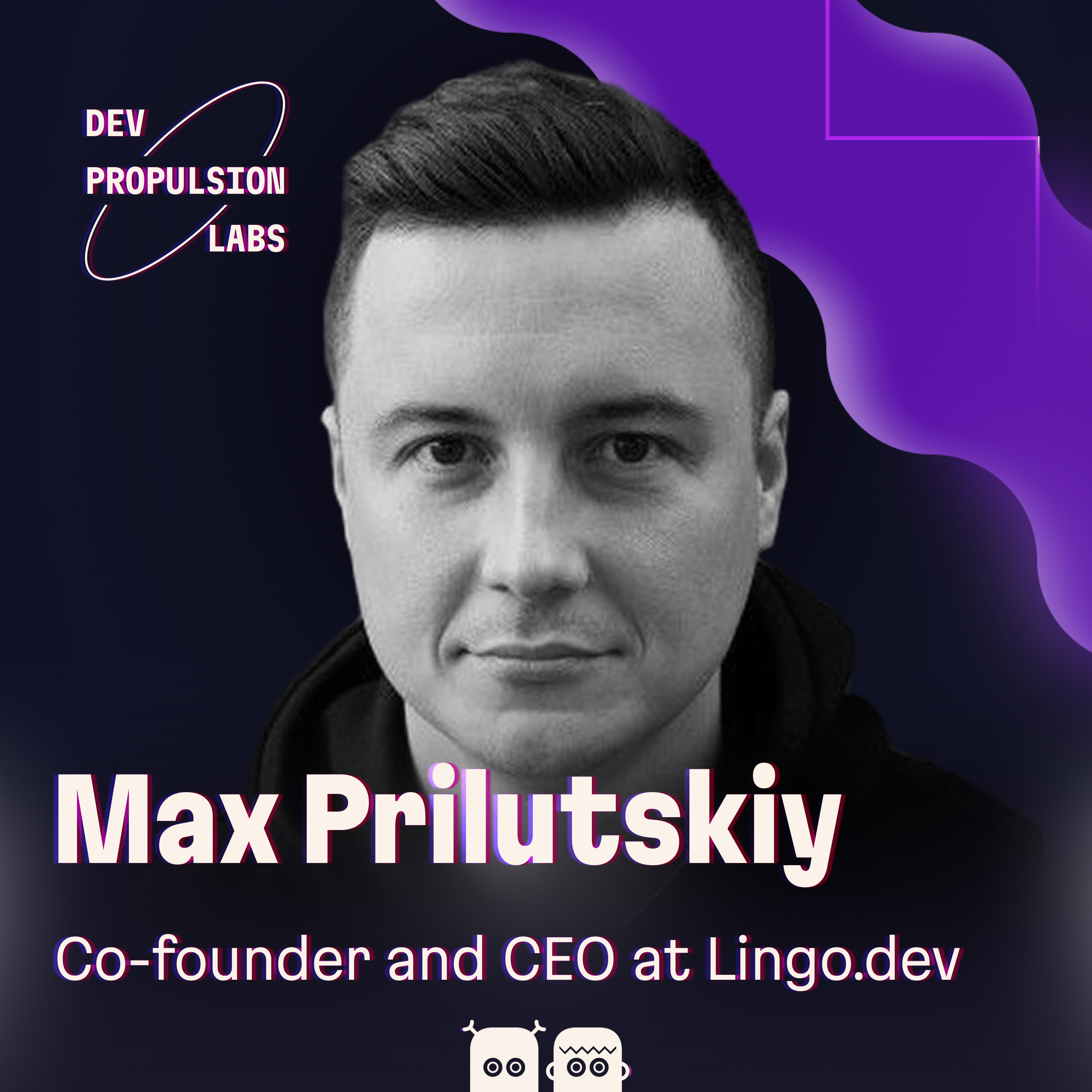


Max also shares rebuilding the Lingo.dev platform from scratch, how source code beats documentation for AI agents, and why architecture decisions matter much earlier than most founders think.
What we talked about
Max Prilutskiy’s background: from Belarus to Barcelona to San Francisco
Max started coding at nine years old in Belarus, always building side projects without knowing they were called that. He eventually moved to Estonia, then spent four years in Barcelona, where he and his co-founder Veronica bootstrapped and sold their first product, Notionlytics. After the acquisition, they went to a hackathon in late 2023 with no idea what to build. They interviewed everyone they could find and discovered a shared frustration with localization. They built a simple ChatGPT API wrapper with GitHub integration that auto-created pull requests. It won best dev tool.
From hackathon to Y Combinator
After the hackathon, Max recruited early users by DMing people on Reddit and Twitter, asking if they had a localization problem. Users and paying customers required entirely different approaches. To find paying customers, he read Founding Sales, a book he had physically smuggled into Barcelona by posting on Twitter that he needed a copy and having a founder hand-deliver it before a business trip. When the sales playbook didn’t work, he pivoted to pure research calls with no pitch whatsoever. After about 30 conversations, he heard the same words and frustrations repeated back to him. Those words went directly onto the landing page and into outreach campaigns. That’s what unlocked their first customers and, shortly after, Y Combinator.
What Max actually got from YC
Max is candid that YC doesn’t fill your pipeline unconditionally. The network helps, but it doesn’t replace having a product people genuinely want to pay for. What stood out was the optimism of the partners who believed in Lingo.dev at moments when the founders weren’t fully believing in themselves. The uncomfortable questions YC forces you to answer, for yourself first, were the real value.
Rebuilding the platform and shifting the product
After YC, the team spent the year talking to customers and addressing feature requests. In December and January they rebuilt the platform from scratch to serve a much broader audience, with a new emphasis on developer experience. One significant product shift: Lingo.dev moved from being purely API-driven to helping users configure and run the LLM of their choice, reflecting a broader market trend away from buying software toward building your own.
Agent experience: actionable error messages and an MCP tool for i18n
Max pushed back on the assumption that LLMs made copywriting irrelevant. His experience was the opposite. Lingo.dev now writes every error message in three parts: what happened, why it happened, and how to resolve it. That structure isn’t new but it matters more now because agents are consuming these outputs at far higher volume and frequency than human users ever did. To handle the specific complexity of implementing internationalization (i18n) in web apps, where agents regularly get lost across multiple steps, the team built a free MCP tool that guides agents through the entire process without losing context.
Source code as the ultimate documentation for agents
For human onboarding, standard documentation is still the right tool. But for agents working with edge cases or cutting-edge library versions where docs haven’t caught up, Max’s team found that pointing agents directly to the source code in the node_modules directory saved roughly 100 hours during their platform rewrite. The source code doesn’t lie; the docs sometimes do.
Go-to-market: what worked and what didn’t
Word of mouth is the only channel Max calls a gold mine. It’s reliable but slow, and impossible to force. Paid marketing doesn’t make sense for early-stage dev tools. Cold outreach works, but only after you’ve nailed your ICP. Apollo is useful for finding contacts; the emails themselves are written by hand. Product Hunt and Hacker News depend entirely on whether your specific audience lives there. The real unlock was removing all pitches from outreach entirely, running pure research conversations using The Mom Test playbook, and then applying the exact language customers used back to the landing page and messaging.
What Max looks for when hiring
Strong computer science fundamentals and genuine obsession with the craft of programming. For developer tools specifically, caring deeply about code quality shows up directly in developer experience and system design, choices that prevent full rewrites six months later. Max believes the market is shifting toward everyone being at least somewhat technical, and hiring for dev tools has always reflected that.
Transcript:
[00:00:00] Victoria Melnikova: Hi everyone. Welcome to Dev Propulsion Labs, our podcast about the business of developer tools. My name is Victoria Melnikova. I’m the head of new business at Evil Martians, and today I have with me Max Prilutskiy, CEO, and co-founder of Lingo dev. How Max, how are you?
[00:00:21] Max Prilutskiy: Hello. Doing good. How are you?
[00:00:23] Victoria Melnikova: Good, good as well.
Very happy to be to, to have you here and. Sometimes it takes a while to get a, a guest into the studio. So this has been months in the making and make me very happy to have you here today. So thank you for coming. Thank you for having the time. Yeah,
[00:00:38] Max Prilutskiy: thanks for having me.
[00:00:39] Victoria Melnikova: So lingo.dev is AI localization tool, a dev tool.
[00:00:45] Max Prilutskiy: Yeah. We help teams repurpose LLMs, reconfigure LMS in such a way so that they can produce. Great translations, professional translations for their product, for their content that match their brand voice terminology and things like that. We have developer [00:01:00] tools through which those stateful APIs can be used.
[00:01:04] Victoria Melnikova: Mm-hmm.
[00:01:04] Max Prilutskiy: And yeah, that’s what lingo dev is
[00:01:07] Victoria Melnikova: 2026. You would’ve thought that localization is a solved problem, but somehow there is still opportunity. How did you guys came to this idea? How did it start? I, I know that it started in a hackathon.
[00:01:18] Max Prilutskiy: Mm-hmm.
[00:01:19] Victoria Melnikova: Can you give us the, the background on how you, you got started with lingo?
[00:01:24] Max Prilutskiy: Yeah. Our, uh, our purpose today is to help, you know, help produce translations using N lms because that’s the first logical. Thing for everyone to do to switch over from old fashioned machine translations technologies, machine translation technologies to over to LLMs. And we basically make that process efficient, easier, and help use LLMs to create localization engines, stateful translation, APIs.
But originally we started indeed with just a dev tool at the hackathon back in. I think it was end of [00:02:00] 2023. Mm-hmm. Or very beginning of 2024. And yeah, it was always the most painful, annoying problem, like in my previous job at like in general, it just felt like localization for web apps is such a boring thing to do.
Yeah. Usually it’s just like one story points on your Jira board, but then. It, it takes, it takes a lot of time to actually get it merged. So we decided to build a very simple charge, G-P-T-A-P-I wrapper back then, I think back then it wasn’t the most obvious idea to use LMS for translations. Mm-hmm. I think the most popular case for CHARGE PT was to post some poems on Instagram.
So it was very beginning and we basically wrapped the API in a very simple way. Created a GitHub integration.
[00:02:52] Victoria Melnikova: Mm-hmm.
[00:02:52] Max Prilutskiy: That was creating automated commits. Automated pull requests. We wanted Hackathon as the best dev tool. Yeah. So yeah, after that we just [00:03:00] kept going.
[00:03:01] Victoria Melnikova: Mm-hmm. So, and then you took Lingo dev to yc, right?
That was the next stage, or,
[00:03:08] Max Prilutskiy: yeah, it happened. Yeah, it happens a little bit after. So basically we sold the previous product that we worked on with. Veronica with Michael, co-founder. Yeah. And then we went to the hackathon to basically without any idea. Mm-hmm. What to build. Yeah. So it wasn’t, it wasn’t the next idea in the pipeline, nothing like that.
We just like were having fun and we went to the hackathon and we realized that we have zero ideas what to build.
[00:03:32] Victoria Melnikova: Yeah.
[00:03:32] Max Prilutskiy: So we interviewed. Basically everyone that we could find at that hackathon. The sponsors, like other developers teams. Mm-hmm. And we found out at some point that like we all have, like most of them had that problem and we also had that problem in the past.
So the, that made sense to mm-hmm. You know, to build that first prototype that later evolved into lingo dev after hackathon. We just thought it’s fun and we just kept [00:04:00] building.
[00:04:00] Victoria Melnikova: Yeah. And
[00:04:01] Max Prilutskiy: we got our first users. First, and then eventually first paying customers. So these are two, I would say a completely different approaches.
Mm-hmm. Like to get first users and then like not just users, but customers, but we first got users I was recruiting.
[00:04:19] Victoria Melnikova: Yeah.
[00:04:19] Max Prilutskiy: And then myself, like DMing people on Reddit, on uh, Twitter. Offering them to solve basically the problem and like asking if they have like localization problem. And then after that we started focusing on customers at some point.
[00:04:35] Victoria Melnikova: That’s actually crazy. So you’re from Belarus. When I think about a startup ecosystem, I don’t think Belarus necessarily. So you’re maybe one of the few that I know. Growing up there. How did you. Grow that entrepreneurial spirit in yourself? Like was it always there and you just could not resist the pool?
Like what happened? How, what happened in Neo biography that took you to the stage where you’re like, I want to be a startup [00:05:00] founder in sf?
[00:05:01] Max Prilutskiy: So when we started Lingo Dev, we lived in Spain, in Barcelona. Mm-hmm. But originally, yes, I was born in Belarus and I think I’ve always just been building something.
Mm-hmm. Like some side projects I didn’t know. It was called side projects or like startups, but I was always like coding something. I started coding when I was like a small kid, like nine years old, and I just kept like experimenting, doing like writing some programs.
[00:05:33] Victoria Melnikova: Yeah.
[00:05:33] Max Prilutskiy: And I was always just doing something and then eventually we moved to.
Estonia.
[00:05:39] Victoria Melnikova: Mm-hmm.
[00:05:39] Max Prilutskiy: And then after a while we moved to Spain and we lived in Spain for around four years.
[00:05:46] Victoria Melnikova: Nice.
[00:05:46] Max Prilutskiy: And then after we got into ac, we moved to San Francisco. Mm-hmm. So I just, you know, I was going with the flow. Mm-hmm. And it just happened the time now here, so it mm-hmm. I was motivated, not by San [00:06:00] Francisco itself Yeah.
But by building.
[00:06:02] Victoria Melnikova: Mm-hmm.
[00:06:02] Max Prilutskiy: And I just somehow got here. Mm-hmm. Because of that.
[00:06:07] Victoria Melnikova: So what’s interesting is that you’re applying kind of like the best startup practices to how you build products. Like you talk to users first. Mm-hmm. And that’s how you get your idea, right? Mm-hmm. So it’s like problem over product.
‘cause what we see a lot with technical founders is that they’re so involved with their technology and they’re so in love with their project. That’s sometimes it’s kind of hard for them to see. The business aspect of it and almost like reject parts of your project, you know? Mm-hmm. And you did it the other way.
You talked to people, you learned about their problem problems, and you identified something that you’re ready to commit to. Mm-hmm. How does that happen for you? Because you are an engineer, right? So are you not like, attached to your technology?
[00:06:47] Max Prilutskiy: Well, I would say I am. Uh, we all are. I think that that is one of those mistakes that everybody makes, like always.
I think maybe doesn’t even matter whether you are an engineer or like [00:07:00] product person in the first place. I think some kind of attachment always happens, but what’s important is like how fast you are able to like admit reality. Yeah. And move on if it’s the right thing to do.
[00:07:13] Victoria Melnikova: Yeah.
[00:07:13] Max Prilutskiy: So. It’s just different modes.
Mm-hmm. Sometime you, sometimes you need one mode and another time you need mm-hmm. Another mode. Yeah. So depending on the priorities, I think if the, if the focus in the moment is, let’s say developer experience mm-hmm. Or, or like tech innovation, then I think having that attachment is very healthy.
[00:07:35] Victoria Melnikova: Mm-hmm.
[00:07:35] Max Prilutskiy: But if the focus is on getting users, getting customers. Growing the business, then I think that attachment is not probably the number one thing that one should think of.
[00:07:47] Victoria Melnikova: So when we think about your first startup notion, Lytics, right? Mm-hmm. That was the name. It was successfully acquired after some time, right?
You sold it.
[00:07:56] Max Prilutskiy: Yeah. Yeah. So yeah, we, yeah. Together with [00:08:00] Veronica, it was just two of us. Mm-hmm. We bootstrapped. SA product and then kept working on it, and then mm-hmm. Eventually it got acquired, so.
[00:08:07] Victoria Melnikova: So you probably learned a lot in that process, right? Like about getting customers and growing bootstrap without the VC funding.
How do you actually make profit and, you know, those are the things.
[00:08:21] Max Prilutskiy: The biggest learnings from the first time were mostly psychological things about our own selves, because things are very different every time. So it’s like the, the things that work the first time, they do not the second time. Yeah. So, and the market outside, like externally, like a lot of things that change.
So even the things that should work by definition stop working. So it’s very rarely that you can like, transfer a lot of experience between these two things, but you can transfer the, you know, adaptability mm-hmm. The way you approach things like the mindset and like the greet, the, the agency, those things that.
[00:09:00] They like, they are transferable.
[00:09:01] Victoria Melnikova: Yeah.
[00:09:01] Max Prilutskiy: The psychological things. I mean, that’s, that’s probably one of the biggest learnings is like, I mean, we worked at jobs, right? Yeah. And then you leave, and then you don’t have salary anymore. So this sounds very, like, very basic now, but at that moment it wasn’t, it was like, like a big deal.
That takes a lot of like mind share. Yeah. You know, like, oh, like I have certain like runway. And then like, I’m not making any money yet. And like, yeah. So that makes you think differently and prioritize differently. So that’s an important mindset. I mean in in general to take into venture capital because there’s always runway and like of course, maybe sometimes the constraints in general are not that harsh.
Yeah. But you must make them feel harsh in order to. Like to you personally in order to make progress. So I think a lot of things [00:10:00] about, you know, how to, how to manage stress.
[00:10:03] Victoria Melnikova: Mm-hmm.
[00:10:03] Max Prilutskiy: How to, the most important thing actually is the ability to keep going.
[00:10:10] Victoria Melnikova: Yeah.
[00:10:11] Max Prilutskiy: And doing the thing that you believe is the right thing to do, even when you don’t see any immediate progress, any immediate response from mm-hmm.
From the outside world. Mm-hmm. I think that’s. That’s, um, underrated skills because, underrated skill, because I see founders oftentimes make a mistake of like building something for two weeks.
[00:10:33] Victoria Melnikova: Mm-hmm.
[00:10:33] Max Prilutskiy: And then posting about it like two times and then thinking it doesn’t work, and like switching to the next thing.
I think it’s a little bit premature and I mean, obviously you shouldn’t be building a thing for like a year, several years. Yeah. If it doesn’t work. Yeah. But like building something for one week and then, and then like not putting. Almost any, any effort into like, yeah. Figuring things out. I think it’s a mistake, and I think we learned [00:11:00] that the hard way with mm-hmm.
With the first product.
[00:11:02] Victoria Melnikova: So you’re solving a practical problem of localization. It’s a problem that exists and it’s painful for, for many companies, is the passion. For localization there, or you’re more just passionate about solving problems for other people and that’s what drives you. You know what I mean?
Yeah. Like some people are just really attached to the mission, the big mission of their product. Mm-hmm. How is it for you? Is it more pragmatic than that, or
[00:11:25] Max Prilutskiy: It’s both. So it’s, I would say it’s a little bit more polar. I think on one side it’s to help not only the businesses, but in general, like help. The internet.
Mm-hmm. A little bit, even a tiny bit to become a more international space and like more, more like international in terms of like culturally and like languages and removing the language barrier. Mm-hmm. As it like destroying it a little bit is a as like concept. So that’s what motivates. [00:12:00] Me personally. So it was like on a global level.
And also, I mean, we lived in several countries. We were exposed to several different cultures over the past, let’s say 10 years. So that definitely resonates a lot. And every time we spot some cultural differences mm-hmm. Like in general, or especially at our work, it’s like the most exciting thing ever.
Like, oh, like look at like in that language, they actually like. Do like this thing, like in a very different way. Yeah. Look at that. So this part is the most exciting part about localization. The problem solving part is just, is the part that’s exciting professionally.
[00:12:39] Victoria Melnikova: Mm-hmm.
[00:12:39] Max Prilutskiy: So it’s like it’s, it keeps you in shape.
It’s like just there’s always something new. Mm-hmm. So we love it because of that. And then there’s also the third part, which is the technology. Yeah. It just happened that because of ai, like everything is now and has been for quite sometime reshaping.
[00:12:59] Victoria Melnikova: Yeah.
[00:12:59] Max Prilutskiy: And [00:13:00] there is a lot more opportunities to build things that didn’t make sense to build before.
[00:13:05] Victoria Melnikova: Mm-hmm.
[00:13:05] Max Prilutskiy: So on the technological level, that’s. Like that’s, that’s something that we get excited a lot about as
[00:13:12] Victoria Melnikova: well. Mm-hmm. So after selling your first startup, you’re like, that’s it, we’re founders. I’m never going back to work for another company. We just want to create our new project. That was the mindset or where do you find yourself after that?
[00:13:28] Max Prilutskiy: I think all options are good. Yeah. If you choose them, you know, intentionally.
[00:13:33] Victoria Melnikova: Yeah.
[00:13:34] Max Prilutskiy: I think that’s the best, like when you have that privilege to do that. I think for us it was just working on, on new exciting things.
[00:13:44] Victoria Melnikova: Mm-hmm.
[00:13:45] Max Prilutskiy: So if we found back then something, I don’t know, like we, we just didn’t think about, uh, looking for a new job, but we could, yeah.
So it wasn’t, it wasn’t an issue. We just thought, well, let’s keep going and, and just build something [00:14:00] new ourselves. So being our own boss kind of thing. Mm-hmm. Was never in question though of course it, it has its own benefits, but also because you decide like a lot of things, yeah, you experiment much, much more often.
But also, I mean there is a lot of stress or there’s always like, there are always some trade-offs, but yeah, we are, we would be just fine. Like working at a great company or like starting our own company to solve certain problem that we want to solve, that nobody yet is solving in a way that we want to solve it.
Yeah. So, yeah, that’s why we kept going with our own ideas.
[00:14:37] Victoria Melnikova: You know how now there is this notion of YSU cohorts becoming younger and younger, like. I don’t know.
[00:14:44] Max Prilutskiy: Mm-hmm.
[00:14:44] Victoria Melnikova: 18, 19 year olds that build in startups because it’s accessible, right? Mm-hmm. With AI, you can build much earlier. Mm-hmm. I mean, open claw.
Mm-hmm. Open doors for people and things.
[00:14:54] Max Prilutskiy: Mm-hmm.
[00:14:54] Victoria Melnikova: And you were kind of both, I wanna say like experienced founders, right? Because you already [00:15:00] had, you built a startup, you sold it. Mm-hmm. And. You already had some sales following Dev and now you arrive at yc.
[00:15:08] Max Prilutskiy: Mm-hmm.
[00:15:09] Victoria Melnikova: Was it actually helpful for you, the YC experience?
[00:15:13] Max Prilutskiy: Yeah, it’s very helpful. It’s pretty intense. They ask you uncomfortable questions and they make you answer those un uncomfortable, uh, questions like for yourself in the first place. I think that’s, that’s very important Also. I mean, they see a lot of companies, so they see what usually goes wrong. They can pick advice and help you correct the course.
What also is great is the optimism. I think we really needed that. Sometimes we felt like they believe in us more than we are ourselves, our believing in ourselves. So that was great. That was awesome.
[00:15:53] Victoria Melnikova: A lot of YC folks say that. They go there for the network.
[00:15:59] Max Prilutskiy: Mm-hmm.
[00:15:59] Victoria Melnikova: And [00:16:00] they get their first customers at YC within their batch and mm-hmm.
They get a lot of direct feedback from potential users. Right. Because they can adopt each other’s products. Was the network helpful for you in yc?
[00:16:12] Max Prilutskiy: I would say, I mean, generally speaking, yes, it’s helpful. I’ve heard some stories that there are some companies who just like sell to YC companies and, and that those stories were told by non YC founders that, oh, like it’s so easy.
You just enter yc, you sell to every single company unconditionally in your BA and outside your ba and that’s how you become successful. Yeah. So, I don’t know. Show me those companies that’s, I mean, that’s not. That’s not the case in like, generally speaking. Mm-hmm. I think in our case, for example, it’s, it’s pretty well balanced.
Mm-hmm. I would say like, I mean it’s, at the end of the day, it’s whether you’re solving a problem or whether you are not solving a problem that companies are willing to pay for. Mm-hmm. So I wouldn’t say that by entering [00:17:00] yc you get unconditional, you know? Yeah. Pipelines full of like. Leads. So
[00:17:05] Victoria Melnikova: that’s,
mm-hmm.
[00:17:06] Max Prilutskiy: Yeah.
[00:17:07] Victoria Melnikova: So after yc, what was the biggest change that you made to the product? Or maybe a strategy, or maybe even your own perception of what the business should be like?
[00:17:18] Max Prilutskiy: We kept basically addressing all the, you know, feature requests, all the things that we discovered from talking to customers.
[00:17:27] Victoria Melnikova: Mm-hmm.
[00:17:27] Max Prilutskiy: And that was.
Like number one thing that we were doing over the past years, there were like couple of moments, like as with probably every company where things could have been done like faster and things like that. But I think overall we are, yeah, we are progressing. Yeah. I think the most important part is talking to customers.
Mm-hmm. And building the product. Mm-hmm. So that’s what we’ve been doing last year and that that’s what we are continuing to do this year. We rebuilt the platform from scratch in December, January. Yeah, made it [00:18:00] make more sense for much like bigger audience and yeah, hopefully now solving the problem for many more people and in a much more efficient way.
Particularly what changed is that we started to care about. The developer experience much more. Mm-hmm. I mean, we, that’s always been the priority, but only after you give the product into the hands of like real users. Mm-hmm. You understand like, oh, actually developer experience is also about so many edge cases that, and like about the opinion that us, the author have.
It’s like, like about different design related things. Yeah. Product wise. Yeah. A lot of things are changing. In general in the market, one of the things that we see is that there is much more incentive right now to build on things instead of like buying software. Not only like in our industry, but in general because of [00:19:00] cloud code and which we use also a lot and like other tools, uh, similar to that.
In our case, we also had to adapt and. For example, with Lingo dev, we now help not just use like our API, that we do a lot of research in, like to produce great translations, but we help users use the L LMS of their choice. Yeah. And configure them by however they want to produce those good translations that they would, you know, trust once those are deployed.
So. We also kind of shifted the product a little bit, but the general, I would say trend is to build own thing and do it yourself instead of mm-hmm. Buying software.
[00:19:47] Victoria Melnikova: Yeah.
[00:19:47] Max Prilutskiy: I think it’s especially true for developer tools and developer agents and products. I think developers got just much more power.
[00:19:56] Victoria Melnikova: Mm-hmm.
[00:19:57] Max Prilutskiy: To build their own thing, and especially expert [00:20:00] developers who have been like around for like 10, 15 years. Yeah. Lots of stuff are being shipped instead of being bought.
[00:20:06] Victoria Melnikova: It’s interesting, just yesterday I was recording with Matt Billman from Netlify, and we were discussing how he shared a story. He’s hired Proctor message team.
Mm-hmm. And said, oh look, I, I coded this app on Netlify, you know, it’s on Netlify Live. And I do agree with that sentiment that more people even like me who are adjacent to technology but not necessarily engineers themselves. Mm-hmm. Now we have an opportunity to build, right? Like I can create an app and I can use it for my family, for example.
I can share it with friends. So in a way, software is becoming more custom and less cookie cutter for a whole wider audience. And what you kind of brushed on is agent experience, right? Because now you need to make sure that LLMs can use your product well, fast produce good results and things like that.
Mm-hmm. So developer experience is one thing, and agent experience is another thing, and they’re [00:21:00]
[00:21:00] Max Prilutskiy: mm-hmm.
[00:21:00] Victoria Melnikova: Similar in some ways and different as well. Do you find that you need to do something specific? Like for example, recently Obsidian launched the CLI that is used obviously by agents, right? Mm-hmm. Or.
Documentation needs to be really clean and accessible by agents for them to use your, mm-hmm. Your tool. Well, what are some things that you notice in when it comes to agent experience that are becoming deal breakers for LMS to adopt and use lingo.dev. You are not seeing that part of the puzzle just yet?
[00:21:36] Max Prilutskiy: No, there are. There are definitely things that are becoming much more important because of. Yeah, I guess. But interestingly enough, it, it was not like having great copywriting skills. So at, at first when LMS just happened, we all thought, well, [00:22:00] copywriting is done.
[00:22:01] Victoria Melnikova: Mm-hmm. But
[00:22:01] Max Prilutskiy: actually, I now believe that it’s, it’s quite the opposite.
For example, practically what changed for us is how we write error messages. I mean, that’s pretty simple. Like, it’s obvious, but it has to be actionable. So we break it into three parts, like what happened, why it happened, and how to resolve it. So things like that. I think great UX writers have been like using this, I dunno, like for, for past like 50 years or something like that.
And now everybody understands why it’s actually important because previously it was like a hundred humans using the product, a thousand humans using the product. Now it’s. Thousand LLMs use the product. Mm-hmm. And they use it much more frequently. Yeah. And now potentially in, in background with open chloro similar solutions.
Right. So it becomes increasingly more important. So I would say this is number one thing and it, it basically propagates across the stack. It’s not only error messages, but in [00:23:00] general outputs of the CLIs. Mm-hmm. Outputs of. The API calls, so everything needs to be obvious enough for agent to not get lost.
Speaking of which, by the way, internationalization for web apps has historically been this like, like thing that everybody understood that it makes sense. It would bring more users and. Everybody would love to do it someday, but not today because, oh, it’s too much work then. Mm-hmm. If you st, if you just call like tell the agent, Hey, implement i18n, it would just get lost because you have to implement this like lkls, lklcode in the route of, of the webpage.
Then you have to implement like meta text, like different specific things and then some other things besides the just extracting. Besides just extracting text into Yeah. Uh, localization files. So there’s quite a few, like smaller steps that you have to do. And usually because of that LLM like agent, [00:24:00] LM based agent, it would just get lost.
[00:24:01] Victoria Melnikova: Yeah.
[00:24:02] Max Prilutskiy: So what we built is that we built and. Free MCP tool mm-hmm. That basically guides the agent through that process efficiently so it doesn’t get lost. Mm-hmm. And that’s to the point of like agent experience and like importance of copywriting skills as well. Mm-hmm. So I think experiences like this are becoming much more important, and it’s like you have to be intentional with what you write.
Mm-hmm. Not just let LLM like write, oh, like create a landing page for me like in five seconds. But like every word, every choice of. Like sentences and like their structure, it becomes increasingly more important regarding documentation. Uh, we actually, you mentioned that documentation is, is also a big thing.
Mm-hmm. And it has to be actionable. It has to be like ordered correctly so agent can follow. Actually, besides this, we actually also found out that the best documentation, not always, but oftentimes is the source code of the library that you’re using itself. Mm. [00:25:00] And. The reason is because when you’re using, for example.
The cutting edge, like versions of libraries, like better versions of technologies that just been released. It’s kind of stable already, but the dogs hasn’t been, haven’t been updated yet. Right. So the do the dogs, they are just misleading. So they interfere. So, but the source code is the ultimate source of truth.
So we just usually instruct the agent
[00:25:27] Victoria Melnikova: Yeah.
[00:25:27] Max Prilutskiy: To go like, and the package is already there. You use n pm install. It’s in, in the modules directory. The source code is there. Agent can just go there and study the code to understand Yeah, the actual API of things approximately like in like maybe like suggest some usage patterns.
Mm-hmm. So that’s the ultimate documentation for agents.
[00:25:48] Victoria Melnikova: Mm-hmm.
[00:25:48] Max Prilutskiy: For humans, I think documentation, like general documentation is, is still the best, but like for agents especially with. Edge cases and like complex scenarios, the source code is, is the documentation.
[00:25:59] Victoria Melnikova: [00:26:00] That’s interesting because documentation is kind of like interpreter interpretation for human to, to use the code, right?
Mm-hmm. So naturally for a machine, it makes sense to just study the code. ‘cause they can
[00:26:11] Max Prilutskiy: Yeah, I think for, for, for like onboarding type of flows. Yeah. Yeah. And for like getting started instructions or like to, to understand like higher level view over like some tool documentation is like web documentation.
Yeah. Where basic documentation is great. I mean, like, that’s, that’s like, yeah, that’s, that’s obvious. But when you are, you know, trying to combine. A lot of technologies all together.
[00:26:39] Victoria Melnikova: Yeah.
[00:26:39] Max Prilutskiy: And you have certain edge cases that are obviously not documented, that it’s impossible and doesn’t make sense to document them.
The source code is the ultimate mm-hmm. Source of truth. And it helped us a lot during the platform rewrite. I think we saved like around a hundred hours after, you know, after instructing the agent [00:27:00] to look in this source code. As well.
[00:27:02] Victoria Melnikova: That’s crazy.
It’s
[00:27:03] Max Prilutskiy: very powerful.
[00:27:04] Victoria Melnikova: I mean, documentation could also work for discovery, right?
Yeah. So when agents are looking for tools, discovering tools on, on the web, basically. Mm-hmm. If your documentation is well written and. Basically optimize S. Mm-hmm. It’s more likely that your tool is gonna be recommended. Right? Yeah. Let’s stay on this topic for a second because I think go to market is changing a lot for dev tools in general, and I mean, we as a business feel it too because the way we have a very strong inbound traffic, right?
We have a really strong technical blog and we find that the way people are interacting with the blog is changing. And I feel like blog is becoming a less reliable inbound channel in general. Mm-hmm. So for you, what are the main kind of pillars of go to market? What are some things that you have tapped into and found that found the gold Mine, basically.
And what are [00:28:00] some things that you’ve tried and abandoned because it just didn’t make sense?
[00:28:04] Max Prilutskiy: I think word of mouth is. The gold mine as always. I mean, there are pros and cons. Pros that it’s it’s great. It’s working reliably. Yeah. Because it’s not, it’s not something that you can, uh, manipulate and control very easily.
We did learn with time, but like it’s, it’s taking time, right. Other things. Yeah. I mean, documentation is very important actually. Sometimes get your blog articles when I’m researching something. So you have a pretty strong technical blog. Well, I think. Yeah. Optimizing for LLMs, I think it’s, it’s making a lot of sense, but oftentimes it’s just, it’s just common sense.
Yeah. It’s just when you write stuff, it has to make sense.
[00:28:47] Victoria Melnikova: Yeah.
[00:28:48] Max Prilutskiy: It’s not just like you’re describing what you have.
[00:28:50] Victoria Melnikova: Yeah, yeah, yeah.
[00:28:51] Max Prilutskiy: In, in a weird way from like. Purely programming standpoint, you gotta explain it from engineering standpoint, but [00:29:00] speaking of dev tools, but from user engineers. So it’s like when your user is the engineer, like from the user standpoint, essentially.
Yeah. You gotta explain the docs not like the opposite.
[00:29:09] Victoria Melnikova: Mm-hmm. So
[00:29:10] Max Prilutskiy: the opposite is for agents and you know, they can do it by going to, to the source code. So yeah, the documentation is a big, is a big one. Word of mouth, what didn’t quite work, you know, there is a lot of things that didn’t work. Yeah. It’s like, you know, you try a hundred things, two of them work and you just don’t remember those.
Mm-hmm. 98 things mm-hmm. That didn’t, so Yeah. And we discovered them like, uh, like very often from obvious things. So it’s like paid marketing, it just doesn’t make sense for, for like, especially early stage. Yeah. Maybe sit stage companies as well is it’s not the right application mm-hmm. Of resources
[00:29:52] Victoria Melnikova: called Outreach, for example.
[00:29:54] Max Prilutskiy: Yeah. It does work. It does work, but you gotta nail your ICP first. Yeah. So it always does work.
[00:29:58] Victoria Melnikova: What’s your, what’s your recipe? [00:30:00] What are some tools that you’re using for cold reach? For called Outreach and
[00:30:03] Max Prilutskiy: Gmail? Just, yeah, just,
[00:30:05] Victoria Melnikova: but like, do you do any automations with like Apollo or something?
[00:30:08] Max Prilutskiy: Apollo is mostly for, for like.
Like searching?
[00:30:12] Victoria Melnikova: Yeah.
[00:30:12] Max Prilutskiy: I would say. Mm-hmm. And like edges and things.
[00:30:15] Victoria Melnikova: Mm-hmm.
[00:30:16] Max Prilutskiy: We write most of the emails like by hand.
[00:30:19] Victoria Melnikova: Mm-hmm.
[00:30:20] Max Prilutskiy: Yeah.
[00:30:20] Victoria Melnikova: And like LinkedIn, Twitter, Reddit. I don’t know. I know you’ve done Product Hunt in the past.
[00:30:26] Max Prilutskiy: Mm-hmm.
[00:30:26] Victoria Melnikova: But mm-hmm. I feel like it’s less relevant maybe these days, but maybe I’m wrong.
Hacker News.
[00:30:31] Max Prilutskiy: I think it all depends on, on actually the product. Yeah. So these old channels, they make sense in general, but like does your particular group. Of people use it.
[00:30:43] Victoria Melnikova: Yeah.
[00:30:43] Max Prilutskiy: You know, so it can be different for different dev tools.
[00:30:47] Victoria Melnikova: Mm-hmm.
[00:30:48] Max Prilutskiy: So all these channels, I think they need to be, like in general, like all, all, all of, like all of these channels that we just mentioned.
That like all channels in general that
[00:30:57] Victoria Melnikova: Yeah.
[00:30:57] Max Prilutskiy: Theoretically make sense. Need [00:31:00] to be written down. Mm-hmm. And checked one by one.
[00:31:03] Victoria Melnikova: Yeah.
[00:31:03] Max Prilutskiy: But outreach, I think it’s the, the way to go. Like when you’re just getting started. Mm-hmm. I mean, that’s how you. Nail your messaging. Yeah. Understands like what I mean, sometimes it’s even like what words to use on the landing page.
[00:31:18] Victoria Melnikova: Oh, yeah.
[00:31:18] Max Prilutskiy: You know, because you’re saying the same thing again and again, again and again. Yeah. And then you are looking at your message and you’re like, it’s cringe. I need to rewrite. It’s, you iterate.
[00:31:27] Victoria Melnikova: I think I read something in your, in one of your posts about mm-hmm. Exploration calls. Yeah. Like you learned a lot about how to message
[00:31:35] Max Prilutskiy: mm-hmm.
[00:31:36] Victoria Melnikova: How to do messaging, positioning, value proposition from your exploration calls. Yeah. Is that right?
[00:31:42] Max Prilutskiy: Yeah. It’s uh, an interesting Yeah. Observation that we had. So what we found out is actually was reflected as one of the, in one of the articles, I don’t remember who posted it, maybe A and Z or
[00:31:54] Victoria Melnikova: mm-hmm.
[00:31:55] Max Prilutskiy: One of the top venture firms.
So basically it’s. [00:32:00] It had something to do with like message market feed or message audience feed. That’s how the article was called. And we discovered that by Sure. That, that, so basically when we already graduated, let’s say from that hackathon where the first prototype of ring dev was built, we. Started working on getting our first users.
Yes. So I was basically messaging them. I didn’t really care if they’re paying. Maybe that was a mistake in insight, but like I, I was basically validating whether we are solving something that’s actually, you know,
[00:32:35] Victoria Melnikova: is a problem for
[00:32:36] Max Prilutskiy: people. Yeah. Yeah. That’s actually a problem. Right. So that’s what we were validating back then, thinking about it.
Now, maybe I should have gone after paying customers from the very beginning, but. We were validating that, and then after that we were like, okay, our next milestone is to become our, remain profitable. Yeah. So let’s just rush towards that as as fast as we can. [00:33:00] And I got a book called Founding Sales.
[00:33:04] Victoria Melnikova: Mm-hmm.
[00:33:05] Max Prilutskiy: And actually it wasn’t easy because that that book was, maybe that has changed. As of that time, it was being sold only in the us. I knew it was available online, but I wanted the printed coffee. So I basically posted on Twitter if somebody is willing to bring me that book to Spain. And there was a founder who was actually about to land, you know, about to, to go to Barcelona on like for a business trip or something like that.
And he bought that book. Brought it to Barcelona. I met him and I took that book. So I think that book, actually, that book is also given to every YC founder when they enter yc. Nice. It’s, it’s like a in, in like in this like merge box. So there is this book, but we got it before YCS a little bit. So we got that book and we knew nothing about sales with the period.
Previous [00:34:00] product, it was all inbound. Mm. So it was mostly marketing led and zero sales. So we had to learn everything from scratch.
[00:34:06] Victoria Melnikova: Mm-hmm.
[00:34:07] Max Prilutskiy: So we were executing on that playbook and basically nothing was working. So yeah, I was doing well, the book was recommending. Mm-hmm. But nothing was working. So I decided to switch the tone a little bit and the messaging.
That we used and instead of trying to sell mm-hmm. What we felt, what we felt makes sense for the customer to buy, we just, I decided to just interview the same, or like sent groups or like basically searching for ICP. Like we had several hypothesis and we were checking them one by one. So I was just talking to people trying to understand their perspective on the problem mm-hmm.
That we want to solve and. I think after 30 conversations or so, you [00:35:00] just hear the same thing and again and again. And you understand that people are using the same words, the same ways to describe the problem that you want to solve. Mm-hmm. And you then put those words on the lens page, put those words into the messages, to the messages that you’re sending in the outreach campaigns.
And I think that helped a lot.
[00:35:19] Victoria Melnikova: Mm-hmm.
[00:35:19] Max Prilutskiy: But it takes, I mean, you get a lot of nos when you’re trying to talk to someone. But it starts, it started working actually because we removed all the pitches from like all like campaigns that we were running. It was purely research, uh, led. We didn’t even mention the product that we are building.
It was just about them, about the problem and yeah, their perspective on, on whether it makes sense to mm-hmm. Like solve it. We used the, there is this book called The Mom Test. Yeah. Yeah. We used that playbook and then after that phase we switched to the [00:36:00] sales kind of approach again.
[00:36:03] Victoria Melnikova: Mm-hmm.
[00:36:04] Max Prilutskiy: We got our first couple customers and then we got into a Combinator.
[00:36:09] Victoria Melnikova: Mm-hmm. So now that you completed yc, you raised around, where are you now? Like what’s your, what are your biggest challenges, let’s say? Mm-hmm. Business wise, what are your goals? What are the increments in which you think mm-hmm. Like by the end of the year, we need this. What, what are those items on your list?
[00:36:30] Max Prilutskiy: Yeah, so we have a pretty solid roadmap at this point. Mm-hmm. So I think most of the past year, I think we solved localization for very many people, but we still had this feeling that there is, there is something else that, that we want to have in the product or like in the value proposition and in general.
We were seeking, we were searching for that like shape mm-hmm. Of what we are building. Mm-hmm. And closer to the end of the past year, [00:37:00] we, 2020, closer to the end of 2025, we finally found all the answers that we were looking for.
[00:37:07] Victoria Melnikova: Mm-hmm.
[00:37:08] Max Prilutskiy: Of course, a lot of things have changed since we started and until we got to that point.
So we had to adapt on the go as well. And now we just. Rushing through the roadmap that we know that we are gonna build regardless.
[00:37:22] Victoria Melnikova: Mm-hmm.
[00:37:23] Max Prilutskiy: And that confidence comes from working with customers. Mm-hmm. Helping localization teams, helping developers with localization. Mm-hmm. So biggest, biggest challenge is, well, it’s mostly te technological now because two things.
The architecture has to be built in such a way. So the deploy to production takes. Like my opinion under five minutes. So our, we’ve been almost always under five minutes. Right now it’s 12, but we made a couple of broad decisions so it, it can be brought down to five. So why it’s important, I just [00:38:00] pulled the data.
We, we are a small team, right? We have like six people on the team and with three software engineers full-time. We merged 56. Pull requests over the past week.
[00:38:15] Victoria Melnikova: Mm-hmm.
[00:38:16] Max Prilutskiy: And those pull requests, they’re like meaningful things. Yeah. So it’s not like something that user doesn’t see.
Yeah.
[00:38:21] Max Prilutskiy: 80% is something that user does see.
[00:38:24] Victoria Melnikova: Yeah.
[00:38:25] Max Prilutskiy: If the deploy takes one hour, you just cannot ship that fast.
[00:38:29] Victoria Melnikova: Yeah.
[00:38:29] Max Prilutskiy: You will just, like one week
just join.
[00:38:31] Max Prilutskiy: Yeah. You will just have this endless view of things that’s like, uh, is, or like things will be deploying in parallel, which is not probably the best idea. Yeah. So it is just, yeah, it just doesn’t make sense.
So you gotta deploy very, very fast. So we solved that challenge. But the second thing now is that you get to the point in your architecture, you get to the point when you have to, let’s say, rebuild things much faster. So you, so you from very beginning need to [00:39:00] make decisions. That are like more future proof that previously maybe you would think this is over engineering.
Maybe. Maybe we are too early. Yeah. But now many more decisions start making sense because you actually get to the point. Yeah. Much, much faster. So that’s another thing that we. Have learned. Luckily we were prepared.
[00:39:21] Victoria Melnikova: Mm-hmm.
[00:39:22] Max Prilutskiy: But that’s another thing that we realized that’s actually, you gotta think about architecture much, much earlier.
[00:39:27] Victoria Melnikova: Mm-hmm.
[00:39:28] Max Prilutskiy: Otherwise you’ll have downtime and all engineering, all engineers will be just like, re like refactoring stuff instead of shipping new features to production. Mm-hmm. So these are the two, I would say, main challenges that we realized we have, but. We were lucky to, to be prepared for them, so.
[00:39:48] Victoria Melnikova: Mm-hmm.
[00:39:49] Max Prilutskiy: Yeah, we are good, but like, that’s something that we didn’t think about much at the beginning.
[00:39:54] Victoria Melnikova: Let’s talk about running a startup with a lean team. Mm-hmm. And that’s your choice, right? Like that’s your strategy. And obviously [00:40:00] with ai it’s easier to ship than any, any time before.
[00:40:05] Max Prilutskiy: Mm-hmm.
[00:40:06] Victoria Melnikova: How do you split responsibilities within the team?
Because you and Veronica are the two co-founders, right? Mm-hmm. You’re both technical.
Mm-hmm.
[00:40:14] Victoria Melnikova: Who is doing what? Like how do you decide who gets what chunk of the pie?
[00:40:18] Max Prilutskiy: Yeah, so great question. So we have six folks on the team, and everybody has computer science degree, so everybody can code when needed. So usually the work looks like.
Tasks, they are not like in, in our project management tool. They are not tasks, but rather definitions of the problems that we have. Mm-hmm.
[00:40:39] Victoria Melnikova: Mm-hmm.
[00:40:39] Max Prilutskiy: And I remember in the past it was a, like pretty normal practice to have a task to investigate something. Mm-hmm. And then like other tasks to actually implemented something.
[00:40:51] Victoria Melnikova: Mm-hmm.
[00:40:51] Max Prilutskiy: So we don’t do that. The task is like, is like to, to get it done. Mm-hmm. So if you don’t know, you go find it out. If you need to [00:41:00] involve others, you do that. But the task is, it means that it needs to hit the production server. So that changed in terms of how the work is organized.
[00:41:09] Victoria Melnikova: Mm-hmm.
[00:41:10] Max Prilutskiy: Also, everybody on the team is pretty senior in their career, so they don’t require.
[00:41:18] Victoria Melnikova: Handhold,
[00:41:18] Max Prilutskiy: uh, handholding. Yeah. And everybody’s pretty much like an acting, like an architect of their particular thing
[00:41:25] Victoria Melnikova: mm-hmm. That they’re
[00:41:26] Max Prilutskiy: working on.
[00:41:26] Victoria Melnikova: Mm-hmm. So it’s very high agency team. Right. Like, you just get kind of a piece of responsibility. Mm-hmm. And you own it.
[00:41:34] Max Prilutskiy: Yeah. Yeah. Exactly. Also, everybody’s in the channels with the customers.
[00:41:37] Victoria Melnikova: Mm-hmm.
[00:41:37] Max Prilutskiy: So they see how customers use it, what they say, like, like what feedback they give. Everybody replies to the customer when something is fixed. So yeah, it’s, it’s working pretty nicely.
[00:41:51] Victoria Melnikova: Sounds great. And between the founders, do you, do you have complimentary skills? Like are you more on the business side and is more on the technical side, [00:42:00] or how do you that?
[00:42:00] Max Prilutskiy: I think with dev tools, everybody, it just happens that. All founders are both technical or like oftentimes it happens that both founders, or like all founders, they eventually, they either originally are technical or eventually become technical enough to be called technical, you know? Yeah. So in our case, we were originally like tech founders and the rest, just like we learned.
Mm-hmm. We learned the rest. We split the work. I think it just. Somehow, naturally. Mm-hmm. So we’ve been working with Veronica for, for like many years together on different things. It just, I don’t know, like there, there are some times like, and the roles always are evolving as well. Yeah. So sometimes we change how we do things Yeah.
And who does what. Mm-hmm. But that’s always like intentional. Mm-hmm. When we see that something like mm-hmm. Change that we need to change as well. Mm-hmm. But usually it’s product related. Questions, uh, planning related [00:43:00] questions is what Veronica is. Data science related, like numbers. That’s what Veronica is best at as a CPO.
Mm-hmm. She is former data scientist, so, uh, nobody will ever do those things better than her. And yeah, myself, I focus more on like architecture, like reviewing the architecture of overall system and, well, I. Everything growth related.
[00:43:26] Victoria Melnikova: Mm-hmm. So kind of growing your startup early stage in San Francisco, in this, in this time of ai
[00:43:35] Max Prilutskiy: mm-hmm.
[00:43:35] Victoria Melnikova: Surge, how does it feel like, is there room for work life balance or you feel like you have to just be working all the time? Or for you it’s not, it’s never work or life, it’s always both. How do you navigate the space? Do you feel a lot of pressure in like FOMO here, NSF, or it’s actually helpful and what you said earlier about yc, the.
Exhilarating culture of sf just being [00:44:00] excited about ai. Mm-hmm. Is something that drives you. Where are you mentally in SF growing an early stage startup?
[00:44:06] Max Prilutskiy: Yeah, good question. So I think regarding work life balance is something that we just intentionally chose to, to dot have. Yeah. It’s just, yeah. So we mostly work, oftentimes you gotta take breaks to kind of zoom out and see if you’re still moving, uh, in the right, going in the right direction.
But besides that, I mean, it’s, it’s a lot of, a lot of hard work. Mm-hmm. A lot of experimentation and a lot of hours and so, but it’s a choice. So like, it’s not, it’s not something I would ever complain about. It’s, yeah, I love that. Regarding demotivation and fomo. I wouldn’t say I feel that, but like it’s generally, I think the vibe is very, is very dynamic.
Mm-hmm. So some oftentimes, like every, like every time something is going on somewhere, something new gets launched, then [00:45:00] big tech launches the same thing the next week. Then another startup does the same thing, but better the week after that. Mm-hmm. So I think. This is why I love San Francisco. I haven’t seen that culture in any other place where I lived.
So I think that’s, that’s, yeah, that’s very unique to this place. So I really love that. Regarding fomo, I think it’s a, it’s like personal choice. So, I mean, of course you gotta be on top of things and be first in some things and follow up. Fast with other things, but it happens just naturally. Mm-hmm. If you talk to customers often.
So that’s what we try to focus on.
[00:45:40] Victoria Melnikova: When you’re looking for a perfect candidate to join ling.dev, what are some qualities that you’re looking for in people?
[00:45:46] Max Prilutskiy: Great question. I’m looking for strong computer science fundamentals.
[00:45:50] Victoria Melnikova: Mm-hmm.
[00:45:51] Max Prilutskiy: So that’s number one thing that I’m looking for. Obsession about the craft, about the programming in the first place.
[00:45:59] Victoria Melnikova: Mm-hmm. [00:46:00]
[00:46:01] Max Prilutskiy: Speaking of, uh, engineers. Right. So these two things, because especially the letter, the, you know, the care for the craft for programming is especially important for developer tools. Mm-hmm. Because it reflects some great developer experience. Mm-hmm. It reflects in architectural system design choices that, you know, that don’t lead to fully rewrite six months after.
[00:46:23] Victoria Melnikova: Yeah.
[00:46:24] Max Prilutskiy: So that’s why it’s very important. So yes, strong computer science fundamentals. Well, uh. Experience and yeah.
[00:46:33] Victoria Melnikova: Mm-hmm.
[00:46:34] Max Prilutskiy: Motivation to write great code.
[00:46:37] Victoria Melnikova: Do you think you will arrive at a point where you’ll need to hire marketing and salespeople that are not necessarily from computer science background or for you it’s always gonna be some sort of interdisciplinary person that
[00:46:51] Max Prilutskiy: mm-hmm.
[00:46:52] Victoria Melnikova: Can tap into both?
[00:46:53] Max Prilutskiy: I think we are entering phase. When everybody’s becoming more or less technical.
[00:46:59] Victoria Melnikova: [00:47:00] Mm-hmm.
[00:47:00] Max Prilutskiy: It’s like at least technical, you know, enough to like be called technical. Yeah. Not necessarily like engineer, but mm-hmm. Technical enough. I think that just will happen naturally. Maybe we will for some go to market roles.
[00:47:16] Victoria Melnikova: Mm-hmm.
[00:47:17] Max Prilutskiy: But at this point it’s mostly
[00:47:20] Victoria Melnikova: product.
[00:47:21] Max Prilutskiy: Yeah. Mostly product. Even like for, I mean, account executive here maybe, but also you kinda like understand at a very deep level what’s going on, so
[00:47:31] Victoria Melnikova: yeah.
[00:47:32] Max Prilutskiy: Yeah, I think it’s uh, for dev tools I would say it’s very important.
[00:47:35] Victoria Melnikova: This brings us to my final question, which is always the same for all founders.
It’s called Warm fazi, and it sounds like this. What makes you feel great about what you are doing today?
[00:47:46] Max Prilutskiy: Building a product that developers and product engineering teams. Have to use. So that’s, that’s what motivates us.
[00:47:56] Victoria Melnikova: That’s good. That’s good. And I would like to provide you [00:48:00] the stage to invite people to try Lingo Dev.
Mm-hmm. How do they find it? Where do they start? What’s a good application case
[00:48:07] Max Prilutskiy: they can find us at? Yes. Where?
[00:48:10] Victoria Melnikova: Lingo dev. Yeah. Registered trademark.
[00:48:17] Max Prilutskiy: Yeah. Lingo dev. So it’s good when. When quality of the translations is important, you can use the API to create a stateful translation, API, just for yourself using lms, configure it with all possible glossaries instructions, prompt engineer to your liking, and it’ll produce perfect professional translations for the product.
If you’re a little bit early in the journey and you just need something, for example, to look, translate it, or just get the first language, first, additional language. Deployed. You can use lingo dev tools for free. There are open source tools, C-L-I-C-I-C-D integrations that are like dependable, but for translations.[00:49:00]
Some other tools for agents that they, that we have built an MCP server for. Yeah, so that’s for those who are just getting started. Mm-hmm. Yeah. And for localization engineering teams, we have the entire platform to engineer. On translations on quality and get this bird’s eye view over, over the overall quality of all the translations that the organization.
[00:49:27] Victoria Melnikova: Are people using lingo dev to localize games too, or no?
[00:49:31] Max Prilutskiy: No. That’s not something we are focusing on.
[00:49:33] Victoria Melnikova: Okay.
[00:49:33] Max Prilutskiy: Yeah.
[00:49:34] Victoria Melnikova: I’m looking forward to that.
[00:49:36] Max Prilutskiy: Yeah. I think it’s a big one.
[00:49:37] Victoria Melnikova: Yeah.
[00:49:38] Max Prilutskiy: Sometimes when your, your, your character mm-hmm. Says something and it’s a girl. Sometimes it’s translated like if it was a boy. So it’s, it’s, it’s not the most obvious thing.
So localizers usually miss that, but yeah.
[00:49:52] Victoria Melnikova: Mm-hmm.
[00:49:53] Max Prilutskiy: Yeah. Maybe we’ll, uh, get into that space some at some point, but
[00:49:57] Victoria Melnikova: not today. Let me know when you do, you know, so I can access games [00:50:00] and like, I actually realize that I am, I’m. An end user of Lingo do Dev because we use cal.com.
[00:50:09] Max Prilutskiy: Mm-hmm.
[00:50:09] Victoria Melnikova: All the time for Evil Martians.
So actually all the people that have been to our website and booked the call via cal.com, used Lingo Dev, so,
[00:50:18] Max Prilutskiy: yep. Yeah, indeed. Yeah.
[00:50:20] Victoria Melnikova: Cool. Thank you Max for coming and we’ll see you in the next.
[00:50:25] Max Prilutskiy: Thank you.
[00:50:26] Victoria Melnikova: Thank you for catching yet another episode of Dev Propulsion Labs. We at Evil Martians transform growth stage startups into unicorns, build developer tools, and create open source products.
If you, a developer tool needs help. With product design development or SRE, visit evil martians.com/devtools. See you in the next.