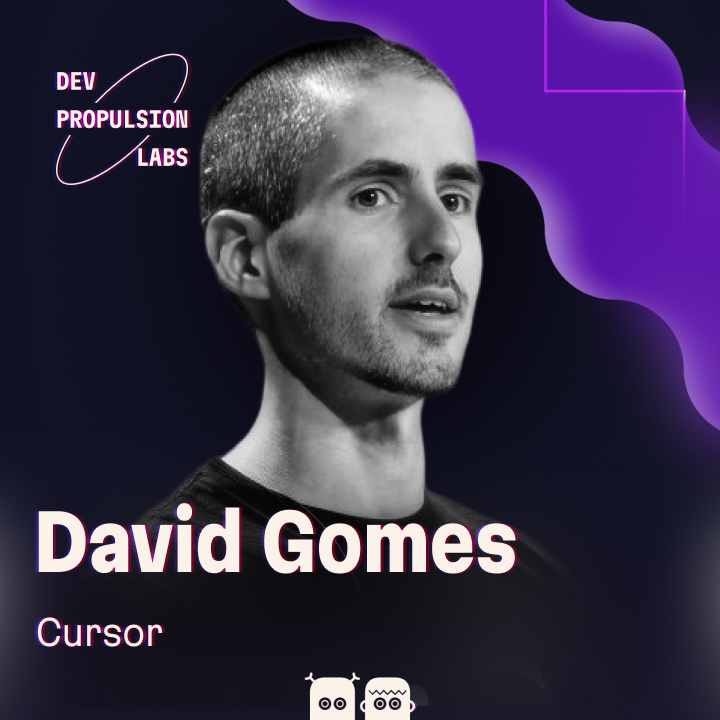

David Gomes, product engineer at Cursor, sits down with Victoria Melnikova to talk about why the world’s best engineers are fully adopting AI while half of developers haven’t started, why AI coding is a learnable skill that takes practice, and how he built a 50-person engineering team in Portugal from scratch. He shares what it was like going through Neon’s $1B Databricks acquisition, why diverse teams outperform business-obsessed ones, and why his next company will be his own.
What we talked about
The future is here, it’s just not evenly distributed
David says around 50% of the world’s software engineers still aren’t using agentic coding. The best engineers — people like José Valim and Jared Sumner — are fully adopting AI and producing most of their code through agents. But outside the SF bubble, most developers are still on copilot-style autocomplete at best. The tools aren’t magic yet: they require practice, prompting skill, and understanding of models, rules, skills, and MCPs. David sees this as a massive market still to capture.
Every engineer at Cursor codes differently
Even inside Cursor, workflows vary wildly. Some engineers live in the CLI. Some run cloud agents from the web UI or mobile app. David personally uses Cursor’s Best-of-N feature — launching three Codex and three Opus models on the same task and picking the best output. He doesn’t see a path toward uniformity anytime soon. Software engineers have always customized their environments, and AI coding is no different.
From competitive programming in Portugal to building a 50-person team
David grew up doing competitive programming in Portugal, dreamed of moving to SF since high school, and got there right after university. At SingleStore, he convinced the company to open an engineering office in Portugal and grew it from zero to 50 people. He argues Portugal is ideal for a first European office: the right time zone (8 hours from SF), exceptional English skills (because they don’t dub TV), and a lower cost of living than Ireland or the UK.
Inside Neon’s $1B Databricks acquisition
David worked at Neon under Nikita Shamgunov — his second time working for Nikita after SingleStore. He describes Neon’s product as “Postgres, but easy and cheap” with rocket-ship revenue growth. The $1B acquisition by Databricks was, in his words, “one for the books” — especially for a company created just a few years earlier. He credits Nikita for negotiating to keep Neon as its own brand and product post-acquisition.
Why diverse teams beat business-obsessed teams
David used to be frustrated when engineers didn’t care about business goals or competitors. He’s since learned that teams work best when they’re diverse in orientation — some people obsessed with the technology, others focused on the product and market. The key is directing each person’s energy toward work that matches their strengths, not forcing everyone into the same mold.
The engineer-manager pendulum and startup ambitions
David references Charity Majors’ blog post about alternating between IC and management roles throughout a career. He’s done exactly that — IC to manager at SingleStore, IC to manager at Neon, now IC at Cursor. He chose to be an IC right now because he wants to put in reps on AI coding before managing again. He says his next company will be his own, but keeps getting offers he can’t refuse.
Transcript:
[00:00:00] Victoria Melnikova: Hi everyone. Welcome to Dev Propulsion Labs, our podcast about the business of developer tools. I’m very excited to introduce today’s guest. Please welcome David Gomes, product engineer at Cursor. Hi David.
[00:00:20] David Gomes: Hi Victoria. How you doing?
[00:00:21] Victoria Melnikova: I’m good. I’m good. How are you?
[00:00:23] David Gomes: Doing fantastic. Fantastic.
[00:00:25] Victoria Melnikova: I’m glad to be back to, to record it after New Year’s break.
I took a while off, so I feel energized. I feel like the creative just isn’t flowing. Must Yes.
[00:00:35] David Gomes: Yeah, that’s, that’s a great start. Being energized. I’m energized by all the work that we’re doing. Also by some of the incidents that I’ve been helping resolve. So I’m also carrying that New Year Energy.
[00:00:51] Victoria Melnikova: That’s very nice.
Just the other day, we went to this dinner where we talked a lot about agents and observability. The dinner was hosted by [00:01:00] Databricks Neon and Sentry, let’s put it like that. But we also had some interesting people, the Peter, the creator of Open Claw, which is. All the talk these days and just catch us up.
So we are in a bubble. We’re in SF and everybody’s hyper aware of what’s going on with the agents and you know, with the whole AI landscape. But beyond this bubble, I don’t think people know what’s going on. So as somebody who is really well versed in the industry and is literally shaping the experience of the future.
Where are we are today as far as the professional coding workflows go?
[00:01:44] David Gomes: I think we live in a very asymmetric world. Another way to say is that the future is here is just not even only distributed, right? Because on the one hand you’ve got products like Open Claw and people that have completely [00:02:00] automated a large portion of their personal life and then on, on their work life.
They’re also automating everything with things like Codex. Automations, cursor automations, and they’re living like in a, in a world where they have their agent swarms doing work for them both, you know, at home and in the office. But the vast majority of software engineers in the world are probably not really using magenta coding very much.
They might be trying things like copilot tab and even cursor tab to like do some auto complete, but I believe. Probably around 50% of the world’s software engineers are still not really adopting agent coding. And that’s crazy to think about because there’s still so much of the market to capture. And in the case of, of like personal agents, I don’t even know what the current OpenAI, DAOs daily active users [00:03:00] is on their main product chat, GPT, I think the most recent number is like a billion.
If that’s the case, then there’s still another 7 billion people in the world that don’t use any of these AI products, let alone the full blown assistance like open clock. So we’re absolutely in a bubble, and there’s still so many people that haven’t even heard about these things that are going on. So yeah, there’s a lot of work for us to do to get these innovations out into the real world.
[00:03:33] Victoria Melnikova: I moved to SF in March of 25. So it was really, it felt like everything is changing, like as you step, a new term is coming out, something else, like the new models are coming out and things are just changing drastically day by day. And what I realized, I work with developers, right? And I, I work with early stage technical founders.
And what I realized that is developers are [00:04:00] often against change. They don’t feel comfortable with things changing that fast, and there was a lot of pushback from developers that I know. I would even say that junior developers were more open to trying new things than senior developers because it felt like a compromise.
It felt like their compromise in quality, and there is no way to actually rely on something that’s not secure, not stable, not clear. Unpredictable outputs, et cetera, et cetera. And now I’m in a stage where I see people like Jose and Vladi di, the engineers that I work with that are really senior engineers that are putting out open source projects and things like that.
They’re adopting AI workflows. They’re getting really great results with that. And it almost like you have to take the leap of faith and jump into it and really like master that skill. Instead of just kind of trying to one shot and expect a failure, [00:05:00] you know, what’s your overall kind of understanding of the room’s temperature?
What? What do you find when you speak with developers? What’s the overall kind of vibe? And I’m curious, ‘cause I’m sure you still have a lot of connections in Portugal and Spain and how engineers feel there versus here in San Francisco.
[00:05:19] David Gomes: Yeah, I would say all the world’s. Best engineers are fully adopting ai.
I think you mentioned, I think Jared Summer, the Creative bond is another good example of someone that’s very public about their AI usage and about like how little code is being written manually nowadays, even by the most professional, so-called a hundred action engineers. Most of the code that’s being produced is agent written and.
That hasn’t reached the rest of the world yet. And you’re right to bring up [00:06:00] Europe. Like I, I obviously live in Spain and yeah, I think, I think we’re in general the communities there are a bit behind San Francisco. That’s always been the case even, and think about React. When React came out, all the startups, CNSF started using React before 1.0.
And other communities lag a bit behind. That’s totally normal and it also gives us time to work out the kinks in the software like the, the truth is that the agentic coding tools are not perfect out of the box. You do need to exercise, you do need to get your reps in, you need to practice a lot before you are actually able to let the agent take control.
It takes. Practice. It takes some amount of skill. It’s basically like a new thing that you have to learn as a software engineer. And so it’s, it’s understandable that not everyone is picking it up yet because the tools aren’t perfect yet. They’re not just things you can [00:07:00] let go and, and just forget about.
You do need to be very much paying attention to how you prompt and to which models you’re using. It’s not magic yet. And for that reason, only the early adopters are really like. Doing the work to learn about rules, skills, commands, hooks, cps, all these things. I think eventually all this complexity will simplify and that will help developers who are maybe less attached to, to the zeitgeists.
Adopt ODing fully for their work.
[00:07:36] Victoria Melnikova: So one, one pattern that I see also is that every engineer that I mentioned, or many more engineers, they kind of have highly personalized workflows. It’s something that’s. That works for them really well, but if another engineer were to adopt the exact, the exact same thing, it might not work as well for them.
I’m curious to learn about your workflows. What are [00:08:00] some tips and tricks that you find work really great for you? And do you believe that in the end will arrive at something that’s a little bit more structured where people can adhere to? Like it doesn’t have to be that personalized and it’s gonna work for many engineers across the board.
[00:08:19] David Gomes: So I, I can share that even inside Cursor, the way people work is very differently. So we have engineers that are pretty much only using the CLI. So they’re in the CLI all day, and that’s just how they like to work. Maybe they use the ID every now and then, but they’re almost exclusively working from the CLI.
We have engineers that are, I say cloud agents built because they consume most of their tokens through cloud agents, and maybe they’re using the web UI for that. Maybe they’re using the mobile app for that. But essentially the agent is operating in a VM in the cloud. And then even inside [00:09:00] the remainder of the people that are using like the traditional cursor desktop product, there’s people that are more agent driven than others, and even.
For example, the way I use Cursor is a lot of my prompts are Multimodel, so I will pick three Codex and three Opuses, and I’ll just have them compete on the same task at the same time. We call this feature Best Event, and I love this feature because it allows me to compare the output from different models, and then I can basically choose the code that I’m happiest with.
There’s other people at Cursor that uses a lot. There’s some that never use this, so it’s very unique. I don’t think I see a path towards this becoming more uniform anytime soon. Mm-hmm. I think software engineers have always liked. Their own little, I, I have my, my neo vim [00:10:00] set up exactly how I want it. I have my VS code like extensions that I live for, and I, I cannot live without them.
So I don’t think we’ll have a very uniform world at least anytime soon. I think each one of us is gonna have their own setup and their own own way of working.
[00:10:17] Victoria Melnikova: So you kind of bring up this question of developer tooling and obviously the agents are developer tools, right? Because it’s something that developers use to achieve whatever result they’re trying to achieve.
But if we talk about the future of developer tool, and it’s changing also, right? Like observability is a run and joke, right? Like, what’s observability these days and how, how is that gonna change? What tools do we need to actually make sure that we produce a secure, stable, reliable result with, you know, with great quality?
And what about. What if we dream even bigger and think about this the way we’ve been writing code as humans is wrong and machines are much better at that than us and [00:11:00] they don’t need to stick to our structure and things like that, you know? So when you think about the future of developer tooling, what do you imagine to be in a toolbox of an engineer in a couple of years?
[00:11:13] David Gomes: I think it’s so hard to to imagine that far out. Let’s take a, a step back and think about how we debug production errors. Right? So around a year ago, I think when Sonnet four Zero came out, we got into this state where you can now go to like Datadog or Sentry copy paste some error logs or, or some trace and some callback errors and just paste them into your agent and it can maybe figure out like.
What the bug is, and maybe it can fix it. You might need to help it a little bit more. Recently with the new wave of models that are even better, and with the new wave of tools, you have [00:12:00] better solutions for debugging now. So for example, last week I was involved in an incident and I tried the Datadog MCP server and it was mind blowing.
You just based a request ID in your agent. You connect the Datadog MCP server and now the agent can look at all the spans in Datadog. Look at all the logs and and metrics. It can look at the code at the same time, and the agents are, the models now have enough context window and they have enough quality in general that they can like look at the logs, look at the code, and do what you would do.
And so you just type a very simple, nice prompt and you get a really good bug fix for whatever happened in production. But that leads me to thinking, why is there even a human in this loop? Right? If there is an error in Datadog or in sent, maybe the next step is to automatically launch like a cloud agent that [00:13:00] has the MCP server and it has the code and it can open a pull request for me.
So maybe, I think we’re very close to this actually. I think maybe in, in, in one month, I’m gonna wake up to pull requests that are coming from my. From my agents, from my ai, SRE. I think some tools already, already have this, and so if you extrapolate and you continue on this path, what about six months from now?
Am I even reviewing the change at the end of it? Or maybe I’m getting a weekly report of all the agent fixes that happened during the week, all of the incidents that. We’re basically completely run and completely solved by agents, and I just basically attend the post-mortem review at the end of the week.
And I’m not reviewing much of this code, many of these fixes and you have agents review each other’s work. It sounds a bit scary when you, when you put it that way, but it’s a, it’s very [00:14:00] possible that we are headed towards a world like that. Like it, it, it definitely seems. If you look at the progress so far, if you like generate two iterations on top of this, it feels like we’re headed into that kind of world.
[00:14:18] Victoria Melnikova: I’m smiling a lot because it reminds me of this. So I’m a little bit scared of flying on the planes, right? And I have this feeling that I kind of need to look out the window to control how the plane is flying. So it’s very similar to that. If we really think about it, humans are afraid of losing control, right?
Like we are afraid to let go. What is, what is this machine gonna do? You know? But if that machine is actually better than us at detecting those things, like do we actually need to be those eyes that check off the boxes or say yes or no? That’s a very interesting question, and I’m very curious to see how it unravels it.
It is a little bit like, I [00:15:00] have chills from thinking about it, but. I’m also excited because I feel like we finally arrive at a place where humans are actually free of all the mundane work. That’s not interesting. Like would it be more exciting to create and build and do more creative tasks for humans? I don’t know.
So I want to kind of go back in history and talk about Portugal a little bit. So you are from Portugal. I have lived in Lisbon for a few years and I love the country. It’s a, it’s a great place to be. It’s very far from SF and mentality, right? It’s, it’s very laid back. It’s very chill. The more south you go, the more chill it gets.
It’s people are very kind of relaxed and work-life balance is very important. Is there a lot of computer science in schools? ‘cause I read a little bit about you and you went to University of Coimbra. I’m just curious about what it feels like growing up in Portugal. [00:16:00] How do you get exposed to that? You participated in Olympiads and things like that.
Just share that with us. It’s very interesting.
[00:16:08] David Gomes: Yeah. I don’t think Portugal is, is that different from other Mediterranean countries? I can say that now because I’ve lived in, in Spain for almost two years now, and I think the cultures are very, are very similar. And yes, in terms of how we approach work and work life balance, it’s completely different from here in San Francisco.
So I’ve been very fortunate, like I moved to SF when I was 20. I remember I couldn’t even go into a bar because I wasn’t 21. And during my first six months here. I remember thinking that was very odd because back in Portugal I had been going to to to bars for a couple of years and I spent some time here and then I’ve [00:17:00] been just back and forth throughout the last 10 years.
So I, I, I think I have a very good perspective on the cultural differences. Obviously the American culture is much more centered around work and. There’s also a lot of appetite for building. You can tell there’s a lot of like hunger for creating something and there’s almost like no fear about just, I’m just gonna start my own thing.
There are amazing founders in Portugal. There are amazing founders in Spain. There’s great companies. It’s just the ratio of people that are willing to start something versus people that want to join something. Is completely different from the United States. Mm-hmm. Especially the Bay Area, but I think the US abroad, and I think this stems from just very rudely, very deeply settled cultural [00:18:00] differences.
I think for us in Europe, we tend to prioritize more time with family, especially more vacation, I think like. It’s very common. You, you lived in Portugal to basically take two, three weeks off in August. Oh
[00:18:19] Victoria Melnikova: yeah.
[00:18:20] David Gomes: And even around the Christmas holidays to take basically like from December 20th to to early January, these are very common things.
It’s just like part of our culture and here, like the intensity is, is much higher. Like I think people are more. Focused on their career and they tend to plan like a bigger retirement potentially. Right, or, or like leave the, those non-work plans to later in the future. Whereas in Europe, we want to basically every year like take a [00:19:00] bunch of vacation and, and enjoy life a bit more.
I think there can be balance. I think there. There is a world where you can still live in Portugal and you can still be extremely intense. And there are companies doing that, and I don’t, I don’t think there’s any blockers to that. I don’t think there’s really legislation or hard rules that forbid people in, in those countries to, to build amazing things.
And there’s many examples of that for sure.
[00:19:38] Victoria Melnikova: I mean, even the company where you worked on bubble, isn’t it Portuguese? I,
[00:19:44] David Gomes: yeah. All the founders are Portuguese and it was mostly, most of the, the team was always in Portugal.
[00:19:50] Victoria Melnikova: Mm-hmm. So for you coming into computer science was kind of organic, you just had classes in school and you realized that you might might have talent for that, or [00:20:00] how did it happen for you?
[00:20:01] David Gomes: I joined like the. Competitive programming scene in That’s so cool. Yeah. I think I was in ninth or 10th grade when I started like solving competitive programming exercises for fun and, and that’s why I decided to then do computer science in university. It’s a very niche thing. I remember there were maybe less than 100 people participating in the Olympia in Portugal.
I think it’s bigger now, but it’s still to be in high school and to want to do competitive programming is, is very, very niche.
[00:20:46] Victoria Melnikova: But you found your way. You, you were able to. I guess to do what you love. Yeah. And very early on, find your career, right? Because you joined Unbabel as a, as an intern [00:21:00] very early on, right?
[00:21:01] David Gomes: Yeah, I, I did an internship in, in, in Lisbon during university, but my dream was always to move to sf. All of my high school and university friends know this, like I talked about it constantly all the time that I just wanted to move to San Francisco. I tried really hard to make that happen and as soon as I finished my university degree the next month, fortunately I was already here as a kid growing up in Portugal that loves programming.
I always knew San Francisco was the place to be, and fortunately I was very privileged and everything worked out very, very well.
[00:21:35] Victoria Melnikova: So who, do you have particular, specific people that were your inspiration growing up? Like who were you looking up to?
[00:21:45] David Gomes: I don’t know. I must have watched the Social Network movie like, oh yes.
More than 10 times during university in Portugal. There there’s a few like people that I [00:22:00] really looked up to, including the founders of in Babel, and they gave me a great opportunity to do my first internship, but then also the founders of Ample Market and otherwise C Startup, they’re still here in sf.
There’s someone called Fred who came to SF very early on in his career. So I was always looking for the Portuguese people that made their way onto the Bay Area, and I tried to like follow their approach a little bit.
[00:22:29] Victoria Melnikova: You joined the company, single store, and you built out the whole like engineering department in Portugal, is that right?
[00:22:36] David Gomes: That’s right, yeah. So initially I was in sf, but then I decided to go back to Portugal. To basically find that balance. I love sf but I, I want to be like closer to family as well. And initially I was the only person in Portugal, but I basically convinced the company that we should just hire people there.
The level of talent [00:23:00] is tremendous and getting everyone to move to U the US is a lot of work. Just the visa situation is so complicated. Not only do you have to convince people, but even if you convince them, getting them to move, like can take years. And so yeah, we started hiring just one or two friends from university.
Then eventually we, like, we set up like a legal entity, an office, and by the time I left we were basically 50 people working Wow. From Portugal. They still have a, a pretty big office in Lisbon and. There are, I think, three things that make Portugal an amazing place for like your first European office as a US company.
The first one is the time zone. So in Europe there’s only three countries that have the eight hour time zone difference with sf, which is Portugal, Ireland, and the uk. The second [00:24:00] reason is the. Level of English speaking ability. So I found that people in Portugal speak English tremendously well compared.
Yeah. The root of the reason is that we don’t dub tv. Oh yeah. So growing up, like you’re watching all these movies on TV that are not dubbed, and in Spain, France, and and Germany, they tend to dub television and the cinema. A lot more. So people in Portugal, they tend to speak like English very, very well.
And then the third reason is the cost of living is much lower than Ireland and the uk, which are the other two countries that have the the best time zone for working with America generally throughout Europe, there’s great universities. I mean, I think that’s true in all, all the European countries. So I think for a company like Single Star who had grown to a size where.[00:25:00]
Hiring becomes hard and you also want to have like cover the sun for, for operations. We ran a, a cloud service and having SREs in Portugal and SREs in the US made a huge difference in order to be able to respond to issues more quickly. And we were able to hire. More quickly in Portugal because obviously we were more competitive.
Like the, the salaries that we could afford were much higher than the companies that we were competing with in Portugal at the time. It’s changed a bit now. There’s more companies doing this. CloudFlare is, is Datadog, PagerDuty, Docker. There’s now a bunch of them moving to to Portugal, but it’s still a great place for your like first European engineering office, I would say.
[00:25:54] Victoria Melnikova: So when you were in sf, you were not necessarily an engineering leader, [00:26:00] right? So you moved by yourself and then you build a team of 50. Yeah. So what was that journey like and what were some skills that were not obvious, you know, not easy for you to master? Were you in the end kind of like happy and fulfilled with the work you did there?
[00:26:18] David Gomes: Yeah, I’m super proud of the work we did. Definitely in the beginning there was a lot of travel. So I was flying to SF every two months or so. There was like one year where, where I came to SF seven or eight times, and I would say for one to two weeks, usually two weeks. Because single store was a very in-person company.
Yes. And almost everyone was in the San Francisco office and also the Seattle offices, because we already had two offices in the us, Seattle, and San Francisco, it meant that most of the operations were already ready for remote. Every meeting had a zoom link. Every, all hands had like remote q and a, everything was ready for [00:27:00] distributed workforce.
But culture is not just a Zoom link, right? There is all these little things in how you run meetings or even just how people sit together at lunch, right? There’s all these. Micro interactions that happened during the day. And so I was traveling a lot here so that I was always very attuned to the, the culture of the company, which was very SF focused.
And then over time I started, I started having to travel less basically as we hired more and more people in Portugal. And it wasn’t just me, like all the first five or 10 engineers we hired in Portugal. All of them had to travel quite a bit. And then after that. We basically didn’t have to to do that anymore because we had enough people in Portugal to pass the culture onwards.[00:28:00]
Right. We had recruiting in Portugal as well, and it became more independent over time, and so I learned a bunch going through that, that process, and again, I’m very proud. I think I helped the company. Grow into a talent market that is definitely underappreciated in. In general.
[00:28:28] Victoria Melnikova: Yeah. That’s very cool. And it’s, it kind of comes full circle, bringing it back to your home country too, you know, it’s like you’re given opportunities to people.
It’s very exciting.
[00:28:38] David Gomes: Obviously there’s the question of giving all these engineers who are in Portugal, opportunities that they. Weren’t really having at the time. Yeah, this was 20 17, 20 18 was,
[00:28:51] Victoria Melnikova: yeah.
[00:28:52] David Gomes: Yeah. CloudFlare was not in Portugal. None of these other companies that I mentioned before were in Portugal.
A lot of these engineers would probably have to move to the [00:29:00] UK or to Germany to have this kind of job. And then there’s the question of community. We had organized a bunch of meetups and we, we joined other meetups, and then there’s the salaries, right? Like. I honestly believe that we were responsible for the increase in salaries in Portugal for, for the top tier software engineers because we came in with a different approach, right?
A more competitive approach, more American, you could say. And I think that changed the job market and, and it’s still visible to the, the salaries for. Like engineers in, in, in Lisbon now are not just limited to like local companies and, and, and local salaries. They’re, they now have much more interesting opportunities.
[00:29:49] Victoria Melnikova: After single store. You moved to Neon Right? Which is also Nikita Company.
[00:29:54] David Gomes: Yeah.
[00:29:54] Victoria Melnikova: Which makes sense.
[00:29:55] David Gomes: I worked for for Nikita twice. Yeah. Yeah.
[00:29:58] Victoria Melnikova: And [00:30:00] with Neon, you went through the acquisition. Right? So Databricks huge deal. That really shook everybody, I feel like in the Bay Area. How was it working in a new company with, you know, I’m guessing some of the same people, right?
[00:30:15] David Gomes: Yeah, yeah. We, we, what
[00:30:17] Victoria Melnikova: was it like?
[00:30:18] David Gomes: We actually hired a few people from, from single Source, like right after I joined, there were a few people that I, I really wanted to, to bring over and, and, and Neon was an amazing journey. I, I, I, I only basically worked there for a year and a half. Partly because of, of, of then us getting acquired by Databricks.
It was super interesting to see Nikita and the way he ran the business and even all the way through the acquisition, how he maneuvered that kind of exit whilst keeping me on as its own brand, its own product, its own platform. [00:31:00] Right. Like, I think it’s, it’s one for, for the books really, because the product is so simple but so magical, right?
It’s, it’s like, oh, it’s Postgres, but easy and cheap, right? We’ve just made Postgres much easier to use and much cheaper to use for like hobbyist developers. And then there’s all kinds of amazing things you can build on top of it. And. We amassed tremendous popularity with smaller companies and also hobbyist developers.
But we had a few, like bigger customers as well. The revenue was growing like a, a rocket, right. And I think the, the acquisition was just a fantastic exit for all the employees, all the, the investors, I’m sure. The founders too, [00:32:00] in the sense that the, the value I think that that Neon was acquired for is just insane.
Right? Like $1 billion for a company that had been created, I think two and a half years before the, the, the exits, I
[00:32:17] Victoria Melnikova: think in 2022 maybe.
[00:32:19] David Gomes: Yeah. Yeah. Okay. So maybe a few. A few. Maybe it was a bit longer then. But it’s still like an amazing price tag to, to get on, on, on your business. It’s, it’s, it’s one for the books for sure.
[00:32:31] Victoria Melnikova: I’m actually gonna have STAs on the, on the podcast in a couple of weeks, so I’m really gonna kind of zoom in on the acquisition ‘cause I’m really, there’s so many things to discuss and it is just, I think the whole dev to community was watching it like in awe because it was just wild. Now you’re at Curer and you’re building the future for a lot of the engineers.
Your background is kind of like in database products, right? Yes. And now you’re not doing that [00:33:00] anymore and or are you, I don’t know, like what’s the difference? ‘cause from the outside it feels like a very different kind of tool. Right?
[00:33:11] David Gomes: Cursor DB could still be a thing one day.
[00:33:14] Victoria Melnikova: Okay.
[00:33:16] David Gomes: Yeah, this is my first non database company that, that I’ve worked at, and I’m doing, it’s developer tooling.
I’ve always done developer tooling, right? It’s just before I was mainly working on SDKs, CLIs and libraries, and also like APIs and like lower level things. And now I’m more working on the product interface, but it’s developer tooling all the same. A lot of the developer experience properties and things that I’ve learned over the years.
For example, how do you make a CLI ergonomic? Like how do you design the C-L-I-A-P-I like the the CLI flags and that kind of thing. And in the case [00:34:00] of the Cursor desktop product, how do you make the commands ergonomic? The keyboard shortcuts configurable, but also with good default developer experience is.
More universal than, than some people might, might think. And so a lot of the things that I learned working at database companies can actually somewhat be applied working on a more product surface area, which is what I’m doing today.
[00:34:28] Victoria Melnikova: If you reflect on some of your favorite developer tools, and when I say developer tools, I also mean open source projects, whatever it is, right?
I’m talking about things that are actually making you you more performant. More agile as a developer. When you think about your favorite tools, what are some qualities in a great developer tool that you think is a non-negotiable?
[00:34:53] David Gomes: Okay, so the, the first thing is the ease to try it. [00:35:00] So how easy it is to try the product.
I can do a quick comparison of, for example, Versal and CloudFlare pages. Both great products, but Versal has really dialed it in. When it comes to the ease of signing up as a first user and deploying a website. CloudFlare Pages is, is lagging, and understandably why? Like they have a million different products and Versal is just that, but.
Just thinking about deploying a website with CloudFare pages scares me a little bit ‘cause I know it’s gonna be, I’m gonna have to go through a few hurdles for sale. Magical, right? Super, super easy. Another good example is neon. The time from signing up to having a connection string for your Postgres database is, there’s no comparison, right?
If you [00:36:00] compare it even with. They’re closest competitors. I think super base and maybe Prisma Postgres. I think Neon still has like the, that flow really, really like dialed in where there’s no obstacles. Like you just sign up and you can start to use the thing immediately. So yeah, ease of onboarding is definitely one of the first things that comes to mind.
Another one is. Just being able to do things on my laptop as as a local user. So there’s a lot of great dev tooling that you cannot really try from your terminal, and I think that’s really important. I think NEON is, is a good example because yes, they have a a ui but you cannot do, you can do everything with the CLI.
You can brew, install neon, CTL, and you can neon CTL project Create. [00:37:00] Without having to, the, the browser does pop up. It’s just for auth and then that’s it. Like you’re, you’re doing everything from your terminal, from your most comfortable place. That’s really important. I think developers really like being able to do things locally.
When I was at single store before, our product was much harder to try. It was, you would have to like go through a bunch of steps. Before you could actually like then download the CLI. It wasn’t, it wasn’t easy. Right. And the, the DevX bar for, for trying something out is high. Like to the extent that you can, you should try to make everything easy to do from, from even ACL I.
[00:37:49] Victoria Melnikova: It’s so funny because some developer tool founders I’ve met. Consider this complexity of setting up is a feature by design. [00:38:00] You know, like, oh, if they can’t figure out, they’re not my customer kind of vibe. And I feel like we are past that. You know, we’re, we live in an in an age where the market is so saturated and there’s so many tools.
There can be a tool that’s just like yours, but is easy to install or even a little worse, you know? Yeah. And people will opt for that because of that ease. Right. So. I think we often forget that software is a service, right? Like we’re servicing people and we need to your point, become those seamless puzzle pieces that just fit into their workflow without creating friction or fear or intimidation.
[00:38:40] David Gomes: Another good example might be the observability categories. Oh yeah. So I haven’t done this sentry onboarding in a little while, but I’ve set up sentry. More than 10 times? Probably. I mean way, actually, way more, but it’s, from what I recall, it’s just so easy to take the, [00:39:00] the, you choose your language, Python, TypeScript, Java, whatever.
You take the snippet, you put it in your code, and then when you go back to the sensory browser, you can see like your first event. I dunno what it’s like now. I hope they haven’t made it worse. ‘cause that does happen. Like a lot of tools sometimes as they, as they grow, they. Make the onboarding worse, but it, it was always magical and that was always a reason for me to pick Century over anything else.
It just, it’s just easy to try it.
[00:39:32] Victoria Melnikova: I want to switch gears and talk about something else. So you led teams of engineers, right? You are an engineer yourself. Do you try to grow. Internally inside of yourself, a really good understanding of the business. Is that something that you try to instill in people that you work with?
If they’re, let’s say more junior than you and you mentor them or lead them or whatever? [00:40:00] Do you feel like it’s important for a software engineer to understand the business goals and like, why, why am I building this screen? What, what’s the purpose of it? Or is it something like an extra context that doesn’t really add value to, to it?
[00:40:15] David Gomes: Obviously, I would love for everyone to, to be as passionate about the business and, and taking down the competitors as I am, but I’ve also found that. You can be an exceptional engineer who is not that bothered with the business side of things. And so as long as teams are diverse with regards to that, you don’t wanna have a team where like there’s where nobody really cares about the business, but it, it’s okay to have like two or three people that are just.
Maybe obsessed with te the technology or like [00:41:00] one area of the technology and then they, they maybe don’t care as much about the product or the competitors or even the, the landscape that you’re operating in. A few years ago, it used to bother me a lot, but I, I now have enough experience working with, with engineers like that, that I, I think as long as you keep your team diverse, it’s fine.
And then of course if someone is just obsessed about, like, something, as a manager, try to, you know, direct their energy towards the right thing. For example, don’t give them work that requires like maybe doing a lot of competitive research if they’re obsessed about one area of the, of the product. And it’s, if it’s possible for you to keep them in that area and, and they’re like maybe less.
Curious about other things. That can be fine. As long as, as [00:42:00] long as you can direct the right word for them.
[00:42:03] Victoria Melnikova: Speaking to that, something that I’m tr like I’m trying to do for me and for my team, I want us to be very clear about our strengths. Like really have a solid understanding. This is the area where I’m great at, right?
And these are the areas where I’m not great at. I could do it, but it’s like. There are people that can do it better and faster than me, for sure. Do you have that understanding about yourself? Is that something that has come to you easy and you’ve always just known? Or has it been a learning process where you discovered something about you, about you as you grew inside different companies?
[00:42:41] David Gomes: I definitely have it about myself and I definitely pick it up on other people as I work with them. Right. I think. I’ve been at Cursor for six months now, and for most of the people that I’m working closely with, I can already tell what they like to do, what they don’t like [00:43:00] to do as much, what they’re, what they’re their strongest at.
Nobody writes it down, right? You have to. We don’t carry around baseball cards with like
[00:43:09] Victoria Melnikova: our skill bars. That would be cool. That would be cool.
[00:43:11] David Gomes: Some company, uh, some companies do that. I, the, the Ray Dalio principles book is basically all about that, but I think you have to pick it up on your coworkers as quickly as possible.
After joining a new company, you have to quickly identify, okay, what, who’s really good at this, who’s really good at that? And then you have to leverage that to, to get the most out of everyone. We’re not all great at everything. Like that’s just part of being human.
[00:43:40] Victoria Melnikova: I feel like you have an interesting combination because you are an engineer, but you’re also a leader.
And I actually want to invite people to read your blog, david goman.com. Like I love the writing. I think it’s really awesome and it’s really. Lovely balance between personal things and kind of like [00:44:00] lead dev and like hardcore technical stuff, you know? I think it’s just something that a lot of people will find useful.
And I particularly love how you name the articles. I even sent it as reference to our tech editor because. So we work a lot with companies that need help with go to market and ambiguous titles is something that I’m like, I cannot, I have the ick for ambiguous titles and you’re really good at just being very clear about what this article has for you.
You know, I just love that. Anyways, so I think that you have this really interesting, you’re well spoken, you write really well. You have LED teams. You’re an engineer yourself. You have a business. Understanding. Right? So it’s, it’s this founder material, honestly. Like are you thinking about starting something on your own ever
[00:44:54] David Gomes: Before I comment on that.
Speaking of great blocks, one of my favorite blocks is Charity Majors blog. [00:45:00]
[00:45:00] Victoria Melnikova: Mm,
[00:45:00] David Gomes: yes, she is. She is the best writer and she also writes equally. About hard technical problems and also about like more managerial and business problems. She’s great, and one of my favorite blog posts from her is called the engineer Manager pendulum, or the Engineer Manager Career pendulum, which is about how in our industry it’s totally fine for you to be a manager and then be an ic and then be a manager again, and then maybe be an IC again.
And that’s sort of how I want my career to, to be. I’ve been an ic. I’ve been a manager. When I joined Neon, initially I was an ic, then I became a manager at Cursor. I’m now an IC who knows what the future holds. I think this is one of the best things about our industry. For example, right now, I’m very happy to be an IC because [00:46:00] I feel like I need to really, really grow on the.
AI coding skill, right? I wanna put in as many reps as possible on this new style of coding before I venture out into a managerial role. Again, her blog post on this is, is, is one that I quote back all the time, as for building my own company. Absolutely like that is. I’ve always said my next company is gonna be my own, but the problem is that I just keep getting these opportunities that I can’t say no to.
I really thought like I was gonna leave Databricks and start my own thing, but Cursor came knocking in Cursor is just a dream product for me to work on. I, I, I was already using the product all day long. I love the product. I’ve always wanted to work on IDs. And so I couldn’t say no, but definitely my next company is gonna be my own.
I hope
[00:46:54] Victoria Melnikova: I’m excited, like what it’s gonna be. I wanna know. So we actually arrived to the end [00:47:00] of the interview, and first of all, I want to thank you. It’s been a pleasure. And my final question is always the same. It’s called the warm phases question, and it goes like this. What makes you feel great about what you’re doing today?
But you kind of teased it in the previous, you know, in talking about cursor and building, but I’m gonna leave it to you too, to respond.
[00:47:23] David Gomes: We have this customer love Slack channel where people just post like tweets and screenshots of messages from their friends who did something with the product that would’ve taken them weeks or, or, or hours or days without the product.
So that makes me feel. Because we’re, we’re helping people and we’re saving them time, and we’re especially taking out the tedious work. If you’re still doing tedious work, look into automating it because with the [00:48:00] new class of products, cursor, CLO codes codex, you can just, if you’re creative, you can kill all of the boring parts of your life as a software engineer.
So, yeah, I mean, just seeing people talk about the product, that’s, that’s what drives me. I just feed off of that Slack channel. I love opening it every day and seeing what’s new user feedback. That’s, that’s the only thing that matters.
[00:48:28] Victoria Melnikova: Finally, I want to provide you a space to get people to try a cursor.
[00:48:34] David Gomes: Mm-hmm.
[00:48:35] Victoria Melnikova: Or neon or Databricks or single store, whatever you want them to try. I’m sure a lot of. I mean, it’s, it’s probably a non brainer for people to find Cursor and start using it, but I want to provide the floor to you and kind of like engage with our listeners. What do you want them to try?
[00:48:54] David Gomes: Try them all at once.
Seriously. Neon has an MCP server. Plug it into Cursor [00:49:00] and, and build an app with, with Neon and Cursor, like, just use all the things. And then, and then when you need the warehouse, use Databricks. They also have an MCP server. I’m sure there’s a way to use. The products of every company that I’ve worked with at once and won’t be complicated
[00:49:19] Victoria Melnikova: on bubble two
[00:49:21] David Gomes: maybe.
Who knows?
[00:49:23] Victoria Melnikova: Okay. Thank you so much.
[00:49:25] David Gomes: Thank you, Victoria.
[00:49:27] Victoria Melnikova: Thank you for catching yet another episode of Dev Propulsion Labs. We at Evil Martians transform growth stage startups into unicorns, build developer tools, and create open source products. If you are a developer tool needs help with product design development or SRE, visit evil martians.com/dev tools.
See you in the next.