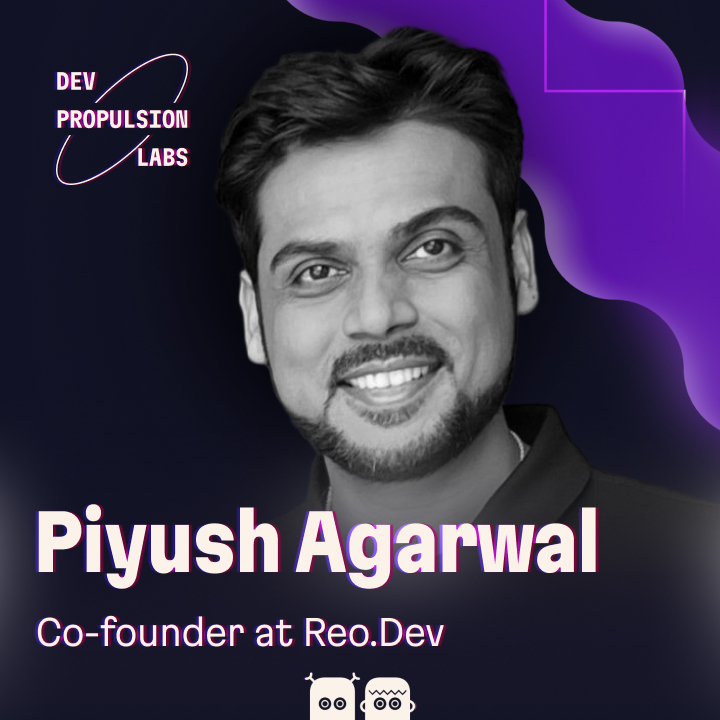

Piyush Agarwal, co-founder of Reo.dev, sits down with Victoria Melnikova to talk about why go-to-market is the hardest unsolved problem in developer tools, how companies can have millions of open-source users and still not know who their customers are, and why timing beats volume when selling to developers. He shares how three months of nonstop customer conversations shaped Reo.dev, why their first product was a Google Sheet, and how intent signals turned a 2% response rate into 26%.
What we talked about
Why GTM is the hardest unsolved problem in developer tools
Piyush says he couldn’t believe a problem this core had remained unsolved. A friend building a devtool startup for four years told him “we go to conferences and run into our customers” — meaning he literally didn’t know who they were. Developer tools have become so vertically specialized that no CTO is an expert across every domain. CTOs sign checks but developers make the technical decisions. That shift has made selling to developers fundamentally different from selling any other software, and most companies haven’t adapted.
How intent signals turn a 2% response rate into 26%
Reo.dev tracks developer behavior across 30+ platforms to identify when engineering teams are struggling with a problem that a client’s product solves. The key insight: reaching out before developers need help gets ignored, reaching out four weeks late means you missed the window. When Reo.dev detects intent — a moment of truth — the response rate jumps from low single digits to as high as 26%. One customer discovered through Reo.dev’s data that Tesla was using their open-source product, and it completely changed their marketing strategy.
The first product was a Google Sheet
For three months before building anything, Piyush and his co-founders spent eight hours a day talking to prospective customers. About 85-90% strongly resonated with the problem. The first prototype was just data sent to 10 customers via Google Sheets. Those early customers didn’t care about UI or UX — they were seeing this data for the first time and it was transformative. That research formed the backbone of everything Reo.dev built afterward.
Why even LangChain and Temporal need GTM help
Piyush pushes back on the idea that fast-growing companies don’t need go-to-market support. Enterprise users are often running open-source products and struggling with problems that the paid product already solves — they just don’t know about it. In 2023, most devtool founders treated GTM as an afterthought. That has completely shifted: sustainability and go-to-market are now at the top of every founder’s priority list.
LLMs are becoming a real marketing channel for developer tools
Piyush says chatbots like ChatGPT and Claude are generating meaningful traffic for Reo.dev and their customers. If you’re not thinking about LLM optimization today, you’re already behind. What works: original, high-quality content that LLMs can pick up as Q&A, and authentic Reddit presence. What doesn’t work anymore: derivative SEO content at volume. The age of churning out keyword-stuffed blog posts is over.
Date the idea before you marry it
Piyush’s advice to new founders: spend serious time validating before committing. Talk to prospective customers relentlessly and be ruthless about concluding when something isn’t working. He sees too many AI founders building without knowing what real problem they’re solving. From his first startup (a computer vision learning app built on Tesseract that was acquired), he learned that the ideas that look romantic from the outside can be disasters if the problem isn’t genuine.
Transcript:
[00:00:00] Victoria Melnikova: Hi everyone. Welcome to Dev Propulsion Labs, our podcast about the business of developer tools. I’m here today with my guest, Piyush Agarwal, founder of reo.dev, and we’ll talk about all things go to market for developer tools. My name is Victoria Melva. I’m the head of new business at Evil Martians and I’m excited to start.
This conversation today. Hi Piyush.
[00:00:27] Piyush Agarwal: Hi Victoria.
[00:00:28] Victoria Melnikova: How are you today?
[00:00:29] Piyush Agarwal: I’m doing good. Thank you so much for having me here.
[00:00:32] Victoria Melnikova: So you just came here from CubeCon? Yes. How was it?
[00:00:36] Piyush Agarwal: CubeCon was a blast for us. CubeCon is a very unique setting because see most of the companies there are there to talk to the developers.
We are there to talk to the people who are selling to developers. For us, it’s like one big convention hall with like two 50 companies, all of whom are customers or future customers. So we work with many of them and therefore some of them are friends. A lot of them we work with [00:01:00] and some of them we would love to work with.
So yeah, all in all I think lovely experience. We also had a small cocktail party at coupon, which was also fun. Yeah. All in all, a good, good trip.
[00:01:11] Victoria Melnikova: What are some other events? So CubeCon is one. What are some others that you target throughout the year?
[00:01:16] Piyush Agarwal: So many. I think Reinvent is a big one. We also go to RSA.
Yes. And we haven’t been doing so many events off late, but I think we’ll do more next year. Mm-hmm. CubeCon, of course, is, is I think the pick up to the lot and then reinvent.
[00:01:29] Victoria Melnikova: Mm-hmm. Yeah. Q. You’re spot on, right? Yeah. Startups that are selling to Enterprise are there, so if you’re selling to those startups that are, you know, selling to enterprise, it’s your place to be.
And the same goes for Reinvent and Nvidia Con for, you know, all of those big ones. How do you prepare for such a conference? Do you bring a demo? You mentioned that you do cocktail hour. What are some other things that you think are important in preparation?
[00:01:57] Piyush Agarwal: We, we try not to do too many demos [00:02:00] on Spot.
Because we understand people are there to interact with their users. So we just kind of introduce them to what we do, and we are there more to just network and tell them what we do. Most of our conversations happen after ours, so we’ll meet somebody at a bar or like we’ll do a cocktail event. So that’s where most of the conversations happen, and it’s a great opportunity to meet customers.
So all of our customers there. You can just meet them in a very natural, like no stress environment, just chill out. That’s what we do mostly. And the pressure is not on to get something out of it. I think it’s just about being there, meeting people, like in the environment where they’re comfortable. And like I said, most of the business happens after our, so
[00:02:42] Victoria Melnikova: if you take a look at ro dot devs customers, you have some really like big names, temporal.
You have NA ran. You know, some growing folks that are very visible in this space and yet you’re not so big. You know, you only have your seed [00:03:00] stage and you have maybe like a hundred plus customers, right? How do you manage to go to get such big names on your, on your radar?
[00:03:08] Piyush Agarwal: It’s all about the problem we solve because like I think we’ve been very fortunate to stumble upon a problem that remained unsolved for so long.
Like it was very hard for me to believe. In a space which is growing this fast, a problem which is so core, has remained unsolved. I’ll give you a story when we are starting Rio, one of my friends is here in the valley. He’s building a DevTool startup. Came out of Netflix, built his own company. I was talking to him about how do you do your go to market?
How do you meet your customers? And one of the things he told me is we go to conferences and we run into our customers, and that just didn’t make any sense to me. How is it possible you’re building it for four years, you have no idea who your customers are. So I think we stumbled upon a very real and genuine problem.
And beyond that, it doesn’t matter. Like today we are working with mega tech. We are working with some of the [00:04:00] biggest capital companies out there. And for them also it was difficult. We are two years old, like who knows how long, you know? But I think the, the problem is genuine. One thing which I think stands as a part is the way we work with our customers always on.
Whenever they need us, we are there. I think that builds trust.
[00:04:18] Victoria Melnikova: So when we talk about the problem, let’s focus on the problem. Mm-hmm. The problem sounds like it’s not very straightforward, right? Yeah. And I think to the people that are outside of this industry, it’s not obvious Yes. As to like what’s so difficult about sales, but go to market for developer tools is a very intricate space.
Let’s put it like that. Developers are pretty opinionated. They don’t buy BS kind of promises. Right. And there’s a lot of complexity in how to approach de developers. So go to market becomes this difficult Yeah. Difficult problem to solve. In your experience, do you think that like what, [00:05:00] what, what, what is the reason why this problem hasn’t been solved for so long and.
Considering that some of the smartest people, you know, build developer tools. Mm-hmm. How come this problem is not solved yet?
[00:05:13] Piyush Agarwal: I think, let’s start with what’s happened in the dev tools industry. Like if you trace the last two decades, the way software is purchased has completely changed. Like if you roll back 20 years, the way it used to be sold was yellow pages.
Like somebody would come sell it to the CTO and then it’s handed down and seven out of 10 times it’s sitting on this shelf. There’s a phrase for it. Shelf air, right? That’s how it used to be sold. Now it’s completely become democratized where developers are the ones who are influencing decisions a lot.
That means a lot. For go-to market, you have to change how you approach GTM, and I think that’s one development. The other piece, Victoria, is that the space is very technical. It’s not like you’re selling toothpaste. Everybody does not need it, right? And if you can’t figure that out, it’s [00:06:00] very hard to sell.
Like try selling a database. To a team who does not need it, it’s just not going to happen. And I think that’s what stands it apart, that the whole crux of solving this go-to-market problem is figuring out who needs it. And if you can’t figure that out, it’s very, very hard to solve. And if you see the best of teams, they have really invested in solving this problem.
And it, it helps because like engineers are no different, like they’re also people. What sets them apart is they’re evaluating a very complex product. They just can’t go by your word. They have to take a look at it. They have to try it out, and when they’re ready, they will talk.
[00:06:37] Victoria Melnikova: So when it comes to ai, now there is this trend and tendency that I see in startups, even at bigger stages where CTOs would play with tools.
Mm-hmm. Themselves. They would take new newent frameworks, they would take new AI solutions and try to build a POC or something else. So. CTOs are also engineers, right? And they also [00:07:00] want to test it with their own hands. But when it comes to selling to enterprise, I feel like it’s becoming even more complicated than before.
When we talk about dev tools specifically, because the, the market is oversaturated. There’s so many AI solutions, and you need to cut through the noise. You need to get to the person who is making decisions. You need to raise your champions. There’s so many things that you need to do as an AI startup to succeed.
So what do you think is the key to solving that puzzle?
[00:07:28] Piyush Agarwal: I think you, you bring a very interesting point. It is becoming more complex to sell a developer tool product. And I fully agree. Like if you think about the last 10 years, developer tooling has become so diverse. Today, no, CTO is a champion or an expert in every vertical of a DE product, like somebody’s good at front end.
That person came from being a front end developer, but they don’t understand cloud, they don’t understand DevOps. So frankly, in a big enterprise, no CTO is equipped to take the final call on a [00:08:00] product. They are just the people signing the check. Because dev tools has become so complicated that every vertical, like today, what platform engineers do.
It’s so far from what a front-end developer or even a data engineer does. So then the variations, the flavors have, I think multiplied a lot. And because of that, CTOs are oftentimes out of their depth. They’re not the best developers in the company, and therefore they’re not the most savvy technical decision makers.
They’re the ones writing the checks. They’re the ones avoiding the risks. But that’s where developers come in, and that’s why it’s become so complex now.
[00:08:36] Victoria Melnikova: So with, with your tool, with reo, you listen to different events, you try to understand intent and meet it with an offer, right? Can you un unpack that for us?
What does it mean? Like, if we take a startup that, let’s say has an open source component, what can RAO do for them that would help them increase
[00:08:59] Piyush Agarwal: [00:09:00] sales? So let’s take, if you’re an open source product. The first problem that you face is even if you have a million or 10 million users, you don’t know who they are, and the point of knowing them is not so that you can, you know, bombard them with emails and sales calls.
The point of knowing them is when they need help, you can proactively reach out to them so that they don’t have to spend hours and hours cobbling up solutions. You probably have a solution to the problem ready, they just don’t know about it. So I think where Rio comes in is starting with. Helping companies identify who needs their product to getting the timing right, because every engineering team is pressed for time, and if you reach out to them before they need it, they won’t respond.
If they reach out to them four weeks late, you already late to the party. So you have to be there just at the right time with the right solution, and that’s what we do.
[00:09:54] Victoria Melnikova: Sounds very straightforward. Mm-hmm. But I’m sure it’s not that straightforward [00:10:00] and. I know for a fact, so Evil Martians have built over a hundred of open source projects, and some of them are really big.
And I was talking to your team about some of the projects that we’re trying to commercialize and one of the issues we are facing there, is there hardly analytics available for what’s going on in the open source. You have this choice. I mean, you have a few customer facing windows. Mm-hmm. Like your open source, your documentation, your website, your social media, a couple of places where you interact with users, and it’s actually not obvious how you can track those behaviors or how you can understand who the, who they are.
So can you tell us a little bit more about like, what is the magic behind this? Like how do you understand what those people need?
[00:10:47] Piyush Agarwal: I think it’s a lot of data gathering and then interpreting the data in a way makes sense. I’ll give you a couple of examples. So most of the developer tool companies have a very well-defined target persona.
Like [00:11:00] you can’t be using that product unless you have a certain engineering tech stack or a certain technological setup. So our solution starts there. Helping you identify what kind of companies might need your product. I’ll give you an example. Like for example, if you take Confluent, if a company has got nothing to do with data streaming, confluent has no business talking to that company.
And you’ll be surprised how often this happens. Like my CTO before we move to the two, Kubernetes would get prospected by Kubernetes companies all the time. And you just take a look at it and realize how deep the problem is. And that’s not even a very nuanced signal. So today, every dev tool company, and as technology is becoming more savvy, and this is not just true of dev tools, it’s true of every industry as technology becomes more savvy, the sub dimensions or the verticals in that industry grow.
And then not every product is relevant for every company. So what we do is we start with helping very sharply define your ICP. What company, what engineering [00:12:00] tech stack or what engineering team might need your product. And then we track the behaviors across all possible platforms and we keep adding more and more.
When we started, we probably were tracking four platforms. Today we are tracking like good part of 30 plus platforms to figure out what are developers doing, where are they stuck, where do they need help. And when we are able to find those moments of truth when we see an engineering team struggle. The odds of getting a conversation are significantly higher.
Like in our overall population, the success rate of getting a meeting is, is in the low single digits. But when we’ve seen intent, that has gone as high as 26%. So one out of every four developers you reach out to, when I say developers, more loosely use term, but engineering buyers, one out of four responds to you.
[00:12:53] Victoria Melnikova: That’s crazy. Each company has an understanding of what their ICP is. Yeah. And the real ICP [00:13:00] can actually differ from what they imagined. Right. Does it ever come as a surprise to what their ICP is like? Does it ever happen to you that you talk with a client and they’re surprised by what they find and in their reports
[00:13:14] Piyush Agarwal: It happens, but it happens a little more with early stage startups.
I think the slightly. Mature companies are less often surprised by what their ICP is. I think they’ve been living with compromises because there isn’t good data available. They’re just going by what’s out there. Like traditionally, just a couple of years back, ICP definition was company size, industry location, and that’s it.
But that’s not how it works, especially if your product is technical.
[00:13:41] Victoria Melnikova: Yeah, that’s fascinating. So if we talk about Rio and the first days and first sales, what did it look like for you? Because. You are operated in a niche that seemingly unsolved. Mm-hmm. Potentially not even be able, like maybe it’s not possible to solve it, I don’t know.
You know, people [00:14:00] can have different opinions on it. So I suspect that there is a lot of pushback. You’re also working with open source, uh, signals, right? So how did you land your first customers as a business?
[00:14:12] Piyush Agarwal: So when I first came across the idea behind Rio. My first reaction was this. It sounds very hard to be true, but then back in the day, my first startup was also in computer vision.
So we used a technology called Tesseract, which is again, open source. We built a learning app on top of it. We had 1.5 million users, and we sold that startup to a much bigger company. And in this entire process, tesseract made. Nothing. I don’t think they care. But still, the whole point is we used somebody else’s work to build a business, exited the business, and whoever contributed the code made nothing out of it.
And that made no sense. So when the problem first came to me, I thought, this is very interesting. We should dig deeper. The first thing we did for three [00:15:00] months, we just reached out to people and spoke to them that, look, this is the problem we are seeing. Are you also seeing the same problem? And to our surprise, about 85 to 90% of them strongly resonated with our thesis that, yes, this is a problem.
How do you solve for it? And if you can solve for it, we are a customer. That research kind of formed the backbone of our entire thesis, what we need to build, how we need to build it. Some people are very generous. They actually shared the screens and showed us what they had put together internally. So our first prototype was just a Excel sheet.
We sent data to our first 10 customers on Google Sheets, and they were very kind to not care about the UI or the ux. They were very happy receiving that data for the first time. I think one of the best moments for us was there was this company we used to work with, they got acquired, and in our data, they’ve got to know that I think Tesla was using their product.
[00:15:53] Victoria Melnikova: Wow.
[00:15:54] Piyush Agarwal: And they had no idea. And after that moment, they completely changed their entire [00:16:00] marketing. It was all about the Kai’s, the biggest companies in the world are using a product. And for us, that was like the first aha moment that, okay, we are onto something here.
[00:16:09] Victoria Melnikova: Yeah, I mean, I’ve seen those stories firsthand once again as, as people who created open source projects that suddenly we know that what the phone is using.
Yeah. Our open source and we had no idea, or Google or somebody else, you know. It’s wild to think that it’s an opportunity that is potentially missed. I mean, obviously with open source it’s, it’s a little bit complicated because not every product can be commercialized, but when we talk about a potential to build something on top of that, potentially build pain features or whatever it is.
Yeah, that’s, that’s just crazy. As I mentioned, you work with some big guys like lying chain and temporal. Why would they need go to market, you know, boost are, aren’t they growing fast enough? Like what? What is the secret [00:17:00] there?
[00:17:00] Piyush Agarwal: They’re never growing fast enough, but I think it is important to go to market because.
You are always, there’s always opportunity out there, right? And the, the more, the stronger your PMF, the bigger the opportunity. And oftentimes in our experience, we’ve been surprised where a company’s been using your open source product and they’ve been trying to solve a problem, which your enterprise product has always solved, and they just did not know about it, or nobody came and told them about it.
And that’s all that was needed to be done. And this is a shift we have seen in the last two years. Like if you roll back to 2023, a lot of dewi founders were not concerned, or let’s put it this way, go to market was not top of their priority list. And we’ve seen that completely shift. The whole priority order has shifted now where everybody’s talking about go to market first, sustainability first.
It’s, it’s very important to think of open source, not just as a charity, but as a, as a business.
[00:17:58] Victoria Melnikova: I’m one of those [00:18:00] people that believe that open source should be commercialized to become sustainable because it’s a big responsibility. It’s a big burden. It could become a burden if it’s not done in a way that benefits the author because as, as we, you know, talk multiple times on this, even on this podcast.
People are very vocal about things that don’t work, but they’re not very vocal about things they that do. So open source can be a very dark place, you know, if it’s not, if the boundaries are not set. I agree. So I think those tools that founders can use, especially at early stages, to even see the potential of their product, I think that’s amazing.
So if we talk about the very early stage startups. What would you say is one thing they need to do to master go-to market?
[00:18:53] Piyush Agarwal: If you are a solo founder? A lot of de tool founders are amazing engineers. Like they’re absolutely phenomenal [00:19:00] at writing top quality code, building some amazing products, but unfortunately, not all of them are good at go-to market.
And if you’re a solo founder, at least you need to be thinking about it from day one. I think some of the companies in our portfolio are. Very successful products, but not very successful companies. And we are kind of helping them cross the chasm, convert the developer love and the popularity into a business.
And I wouldn’t want to be in that stage where you’ve given six, seven years of your life to a, to a project, and now you don’t know if it’s going to be sustainable. Is it financially viable? So I think the first advice would be just start thinking about go to market from day one. You don’t have to monetize.
You don’t have to start selling till you want to start selling, but it cannot be an afterthought. It has to be an integral part of building what you’re building.
[00:19:53] Victoria Melnikova: And there are tools to do that, right? Yes. You don’t have to figure it out from, from the get go, but [00:20:00] something that Adam Franklin shares too, you know, you have to think about what problem your product is solving and reaching those people that are having that problem.
Right? That’s the, the path to product market fit in developer tools. Let’s talk about kind of like the business aspect of it. We are N SF right now. NSF is kind of like the epicenter for developer tools. If you are building in the space or if you’re targeting developers, this is the only place you kind need to be, yet you don’t live N sf.
How do you manage that? Do you feel like if you were here you would be able to reach more startups? What is your general sentiment on that?
[00:20:41] Piyush Agarwal: I think we are. A bit of a lucky spot there because a lot of our customers are developer tooling companies themselves who are themselves very distributed and they don’t really care to tell you like a real anecdote.
Early in our journey, like we changed our s to say San Francisco and New York and stuff, and then [00:21:00] we realized it doesn’t matter, our customers don’t care. So yeah, we are very happily based out of India, but of course presence in the US presence close to our customers matter. We travel a lot. So I’m, I’m here every month.
My co-founder travels a lot. We are doing a lot of events. We are doing dinners with our customers. So yeah, it, it definitely matters if the closer you can be to your customers, the better it is. But so far we are able to straddle both.
[00:21:26] Victoria Melnikova: It’s kind of like a matter of compromise, right? Yes. You still have to travel here every once in a while, and your investors heavy beat are here and you know, customers are here.
So do you think that making that personal touch is instrumental still like. Would you be able to do it completely remote without like ever stepping, you know, putting your foot down in a FI
[00:21:48] Piyush Agarwal: wouldn’t want to. Maybe it’s possible, but because I wouldn’t want to, because some of the best conversations we’ve had have been unprompted, serendipitous conversations like, you just met somebody and like some of [00:22:00] our customers ended up becoming investors in our company.
And the best ideas come from them. I think it is possible to do it fully remote, but we just love the human touch. It’s, it’s good to be face to face, no agenda conversations.
[00:22:16] Victoria Melnikova: Mm-hmm. So for you, Rio doesn’t have an open source component necessarily, right? So do you manage to dog food your go to market strategy?
I know that you have a GTM Academy, right? Mm-hmm. Coming up, and you also have a lot of resources on your website that are educating about go to market. Are those the events that you’re also listening to understand people’s intent?
[00:22:42] Piyush Agarwal: Absolutely. In fact, Victoria, 50% of our customers are not open source.
They’re all developer tools. Half of them are open source, half of them are not. I think what differentiates all of them is a very technical product. Where intent matters a lot. And I think the same thing is true in our business. [00:23:00] Like even for Rio Intent is such a big mover of go to market, and that helps a lot because when you can dog food your own product, it really helps.
You can see it working, your conviction in the product goes up, you know what needs to improve, what needs to change. So absolutely we can’t use a hundred percent of it, but I think the whole concept of using signals. To reach out to the right people Absolutely makes a difference. We have seen that in our business.
[00:23:27] Victoria Melnikova: What are some platforms that you see that are particular important for developer tools right now? So, earlier this year, I was researching Read a lot because there was a lot of kind of like, mm-hmm. I don’t wanna say rumor, but like there was a lot of excitement around how converting Reddit is. What are some platforms that you find are super relevant for dev tools today?
[00:23:54] Piyush Agarwal: I think from a platform perspective, it’s still the same like I do one, one platform, which has become very [00:24:00] important, I think is chatbots like you. You’ve got to be thinking about that strategy because a lot of companies today, including Rio, generating decent amount of traffic from chatbots, and if you don’t start today, then maybe the day you start thinking about it, you’re slightly behind in the game.
I think that’s one platform, which, which has become extremely important. And if you’re not thinking about it, I think you should be apart from that, the other platforms like Google, LinkedIn, credit.
[00:24:29] Victoria Melnikova: So when we talk about chatbots, this is very interesting ‘cause I, I’ve never thought about it to be honest.
So what would be, what, what would be the application of a chatbot? Like you would just put it on your website and. AI agent, I mean the,
[00:24:46] Piyush Agarwal: the LLMs, the, yeah. The AI chat bots, like chat gpt. Oh, yeah.
[00:24:49] Victoria Melnikova: Yeah. Got it. Mm-hmm. And cloud. Yeah. Yeah. A lot
[00:24:51] Piyush Agarwal: of traffic is starting to get diverted from there.
[00:24:54] Victoria Melnikova: Yes, yes. Yes. Are you able to measure it somehow with re
[00:24:57] Piyush Agarwal: somewhat like you can you can UTM tag [00:25:00] some of it?
[00:25:00] Victoria Melnikova: Hmm. What
[00:25:01] Piyush Agarwal: ends up landing on your website? You can measure.
[00:25:03] Victoria Melnikova: Nice. This is actually very cool. So even us El Martians, we’ve seen a few leads this year coming from Perplexity, coming from Che and Claude, like all of them, and I know that are companies that are working on optimizing your website in a way that would feed to L LMS better.
Do you know if there, if there are any established practices already or this is kind of like people are just trying and whatever sticks, sticks?
[00:25:33] Piyush Agarwal: I think people are still discovering what works, but there are some, some ideas which, which you’ve seen work time and again, and I think there’s enough conviction out there in the industry that these things do work.
For example. I think good quality content has become so much more important. It doesn’t matter what volume of content you’re writing anymore. I think what matters more is the quality of content you’re writing, and is it optimized for a chatbot or an LLM to quickly pick it up as [00:26:00] a q and a. I think Reddit has become very important and Reddit kind of keeps becoming the darling and then falling off the favor, but, but you cannot ignore it anymore.
I think you have to be there. You have to be in the conversations, keep it very authentic. But yeah, these are some of the known practices. We have heard things like having content in q and a format helps. Hard to measure. So I, I don’t know the verdict on that one, but I, I’m pretty confident about Reddit and good quality content because that’s what worked for us.
Like we see our Reddit posts, we see our content that we put out there, get, get featured in the chat bot responses. People come from there anecdotally, tell us that we, we are chatting with Chatbar Chat, GPT and got this.
[00:26:45] Victoria Melnikova: Yeah, so
[00:26:45] Piyush Agarwal: we see early signs.
[00:26:47] Victoria Melnikova: If you figure it out, let me know. ‘cause I’m, I’m trying, I’m trying to do that.
I know that once again, earlier this year, there was this fear that content is going away. You know, because blog posts [00:27:00] are not being read as many times because Google is summarizing the content basically. And. There was a lot of pushback to kind of gate keep the content. So right now I don’t even know where we stand with that because it feels like if you produce high quality content, it still works.
Yeah. It’s still generative. It is just, the path looks a little bit different, you know, because it takes you through an LLM, whatever, GPTs. That’s very interesting.
[00:27:30] Piyush Agarwal: Sorry, just on that. I think our experience with GPTs has been, it’s, it’s very good. Derivative thinking, but it’s not gotten to a point where it can do imaginative thinking.
So if you’re creating original ideas, new content, that gets picked up really well. And not just by GPTs, even by people. But if you’re just doing what like SEO firms used to do five years ago, which is just a lot of derivative chunk content that doesn’t work. I think the age of that is gone.
[00:27:59] Victoria Melnikova: What do you think the [00:28:00] future.
Holds for you. So now that AI is kind of changing the way people are interacting with software, or even the way people are building software, do you think that rail will be able to exist in that ecosystem? How do you envision it?
[00:28:18] Piyush Agarwal: So, Victoria, if you see the last couple of decades, every new innovation in technology has brought a flood of developer tool companies.
Like there was Cloud and there was thousands of companies. That were enabling developers to build on the cloud. APIs came and again, thousands of companies, you know, like developer API, companies, postman, the likes of so many other companies that help you API testing metering. We are seeing the same inflection point today with AI.
Today, 50% of my new logos are developer AI companies in some form or fashion. Everybody’s becoming more like a developer, so we only see the trend continuing and yeah, for now, the IVF is riding very high. I [00:29:00] think it, it’s only a couple of years the, the interval between tech innovations is also going down and the next innovation happens.
I don’t know what that will be, but I’m pretty sure that will bring a whole flurry of developable companies.
[00:29:12] Victoria Melnikova: So you’re kind of like this unique, almost unique situation where the problem hasn’t been solved and you stumbled across this diamond of a problem that has not been solved. It’s a challenge because it hasn’t been solved for a reason, right?
It’s a difficult problem to solve. At the same time, the space is vacant. You can take it when it comes to advice to new founders who are just trying to build something but struggle with an idea. You know, there is a lot of this. Trying to invent a problem that doesn’t really exist. So what would be your advice to these new aspiring founders who are just hoping to build something in the space?
What do you think are some problems that are still not solved very well? Let’s put it like that because I’m solved. Problems is a, is a small niche or maybe in [00:30:00] general, what would be your advice to those folks?
[00:30:02] Piyush Agarwal: I think it’s very important to spend time dating an idea before you get married. And just be ruthless about concluding that it’s not working out, because once you’re married to an idea, you are giving it a good part of your life, and you gotta be very sure that this is a genuine unsolved problem.
I think my advice would be just talk to a lot of prospective customers and don’t kid yourself, like if the advice is not what you want to believe, then, then you have to be very prudent about it and just let go of that opportunity and move on to something else. ‘cause it might look very romantic. I see a lot of founders building in AI today without knowing what the real problem they’re solving is.
And that is a recipe for disaster. That is, I think, the step one that you have to get right before you start really committing to an idea.
[00:30:52] Victoria Melnikova: So you are an experienced founder. You already built something and it got acquired, right? So [00:31:00] you did the whole thing. Is the second time around different, do you feel like you’ve learned some things that were really instrumental in getting real off the ground fast and you know, in just a couple of years making it into business that is lending clients like long chain?
I think
[00:31:17] Piyush Agarwal: absolutely. Like the first time around, we made so many rookie mistakes. It absolutely helps having that experience of what you know, what not to do. And of course we are still, I’m sure we’ll still make many mistakes along the way, but hopefully there’ll be better mistakes, more educated mistakes.
I think a couple of things where we focused very, very early on. I think one was idea validation. For three months we spent eight hours a day talking to prospective customers and really debated hard on, is this a problem worth solving. I think the second thing that we focused a lot is getting the right kind of people on board, which continues to be such a big part of what we do every day.
50% of my time goes in either getting the right people on [00:32:00] board or working with people who we have just gotten on board and not trying to solve every problem myself.
[00:32:05] Victoria Melnikova: Yes. How big is your team now?
[00:32:08] Piyush Agarwal: We are about 50 people.
[00:32:10] Victoria Melnikova: Let’s talk about delegation because it’s one of the struggles I would say, especially for technical founders, uh.
Do you struggle to delegate? Is that something that you had to build a muscle to do?
[00:32:23] Piyush Agarwal: To be honest, yes. I, I, I did and I still do because if you’re a founder then you are very used to doing things your, your on your own right? And it’s not natural to you to just have somebody else do it. But I think you have to have your eyes on the bigger goal, which is if you don’t delegate, then you’re not building an organization.
You’re probably building like a hobby and you’re very good at it. So I think it’s a very big important part of our building then it’s, it’s a constant learning process. Mm-hmm. You have to learn from what has worked and do more of it. Not do what has not worked. There’s always this urge to, you know, get in and do it yourself.
Yeah. And you [00:33:00] have to fight that urge every day.
[00:33:01] Victoria Melnikova: Yes. What are some qualities that you look for in people?
[00:33:06] Piyush Agarwal: I think it’s actually very common, or lemme put it this way, the qualities are very consistent no matter what role you are hiring for. There has to be that hunger that you want to build something great.
There has to be, of course, like the, the table stakes here are the smarts, right? The willingness to work hard. But I think one thing where we are very particular about is a little bit of humility that, that there is things that I don’t know, and I’m happy to make mistakes and learn from them. So I think if I were to put it smart, hungry, and humble.
[00:33:39] Victoria Melnikova: Nice. That’s a nice combo. I think that’s, that makes for a great team. Hard to find. Yeah, very
[00:33:46] Piyush Agarwal: hard to find.
[00:33:47] Victoria Melnikova: And actually it’s, it’s interesting that as I speak with founders just like yourself, I find that no matter what stage it kind of remains. I see that as a pattern in developer tools because it’s.
Technical [00:34:00] founders that are working hard, you know, and that kind of like cracked a certain problem and they try to build a team that’s just as hardworking and just as excited about technology and helping people, you know, so it kind of, it’s a nice recipe for a successful team. So we’re approaching our final question, and my final question goes like this, it’s called warm fas, and okay.
It sounds like this. What makes you feel great about what you’re doing today?
[00:34:28] Piyush Agarwal: I think the fact that so many founders are able to grow their businesses because of what we do.
[00:34:33] Victoria Melnikova: That’s very nice. Finally, I want to provide you the stage to invite people to, to try row.dev. How can they find the product? Where should they start?
[00:34:45] Piyush Agarwal: Just come talk to us. I think on our website you can go and sign up or just write to me on LinkedIn. I’m very, very active on LinkedIn, or you can email me posh at Rio Dev. But yes, if you’re selling or if your product is technical. If you’re targeting engineering leaders [00:35:00] or developers, and if you don’t know to spam the whole world, then you should come talk to us.
[00:35:06] Victoria Melnikova: Thank you. I see you in the next. Thank you for catching yet another episode of Dev Propulsion Labs. We at Evil Martians transform growth stage startups into unicorns, build developer tools, and create open source products. If you are a developer tool needs help with product design development or SRE, visit evil martians.com/devtools.
See you in the next.