AI-assisted engineers are burning out, is this fine?


If your mind is always busy, there will be no time to build,
and you will not be successful, particularly if you work too hard on it.– Shunryu Suzuki “Zen Mind, Beginner’s Mind”
We’re more productive than ever. AI allows us to generate code at supersonic speeds, unfold entire modules in seconds, and ship thousands of lines of code. It’s easier to pick up tasks and generate value, even in unfamiliar codebases. But there’s a dark side. AI-assisted code generation isn’t free; there’s a hidden cost that we as an industry are only beginning to realize: AI burnout. Are we dangerously ignorant to this problem? And how can we cope with it?

Across the industry, developer voices are rising, flagging the troubling state they find themselves in: increasing fatigue, a constant race to keep up with the ever-rising pace of work, mixed feelings about AI-assisted coding, and a persistent energy drain. Vibe-coding turns into doom-coding.
We’re dangerously ignorant to one of AI’s biggest hidden costs: BURNOUT!
How did we get here? And more importantly, how do we break this cycle? Evil Martians got together to discuss the subject, share personal experiences, and explore possible solutions. This article grew out of those conversations.
TL;DR
AI-first workflows make you work harder and generate less fulfillment. They contribute to burnout in a variety of ways. To keep our AI workflows sustainable we must:
- Restore enjoyment of the work process
- Rebuild feelings of achievement, ownership, and pride
- Remove the unhealthy inclination to maximize productivity at every moment
There’s a self-help action list at the end of this post that covers all of these points. Use it to push yourself in the right direction.
That said, discovering the root nature of the problem is actually the first and most necessary step toward fixing it. Keep reading to see what fuels AI burnout.
The real question was never about the future of AI
We keep asking: can AI solve problems on its own? Is the quality good enough? Is efficiency the main criteria? Can it eventually replace humans? Personally, I believe the answer to all of the above is: no. But ultimately, this is all future-oriented speculation.
But we’re living in the present. Instead of fueling anxiety by trying to predict the future, we should focus on what we can control today.
If we step away from the narrative that “it’s so over” with each new shiny model, we might actually start asking the right questions:
- Where are these tools actually helpful, and where are they not?
- What’s the optimal way to use them today?
- And, most importantly, how do we keep it sustainable?
We’re so obsessed with AI’s destiny, we’re forgetting about our own.
Will AI outlast the bubble? Probably. Will you?
That’s the question that matters today. And it depends on how you manage your energy, expectations, how you plan your day, and how work actually feels. We need to slow down and make sure we’re taking care of ourselves first. Adopt healthier work practices. Otherwise, we’ll burn out before the future we’re debating even arrives.
AI’s biggest promise (is sort of) a lie
Why do we need AI? At its core, there is one ultimate promise for humanity: the machine now does X, so we can work less. Let the machine handle the boring parts, so we can focus on what we enjoy.
But in reality, that’s not what we see happening.
A study by Harvard Business Review confirms “cognitive exhaustion from intensive oversight of AI agents–is both real and significant” with employees reporting that “the presence of AI tools has increased their workload.”
With AI, people seem to work harder, not smarter.
Why? The answer is surprisingly simple. Let’s do some math.
The math behind the productivity trap
Ben and Alice have 4 hours of software engineering work ahead:
- Ben is an old-school engineer. He codes manually and believes LLMs slow him down.
- Alice prefers to delegate coding to AI and sticks to reviewing.
They both start by planning the feature. Ben does it in his head, Alice composes a plan with an LLM. Then, they implement. Ben physically types the code on his keyboard. Alice watches code being generated, then reviews, steers, and edits. Ben finishes his task in 4 hours. While Alice gets a 2x speed boost and finishes in only 2. So, on paper, it looks like Alice worked less.
But that’s not what actually happened. We have to take cognitive effort into account:
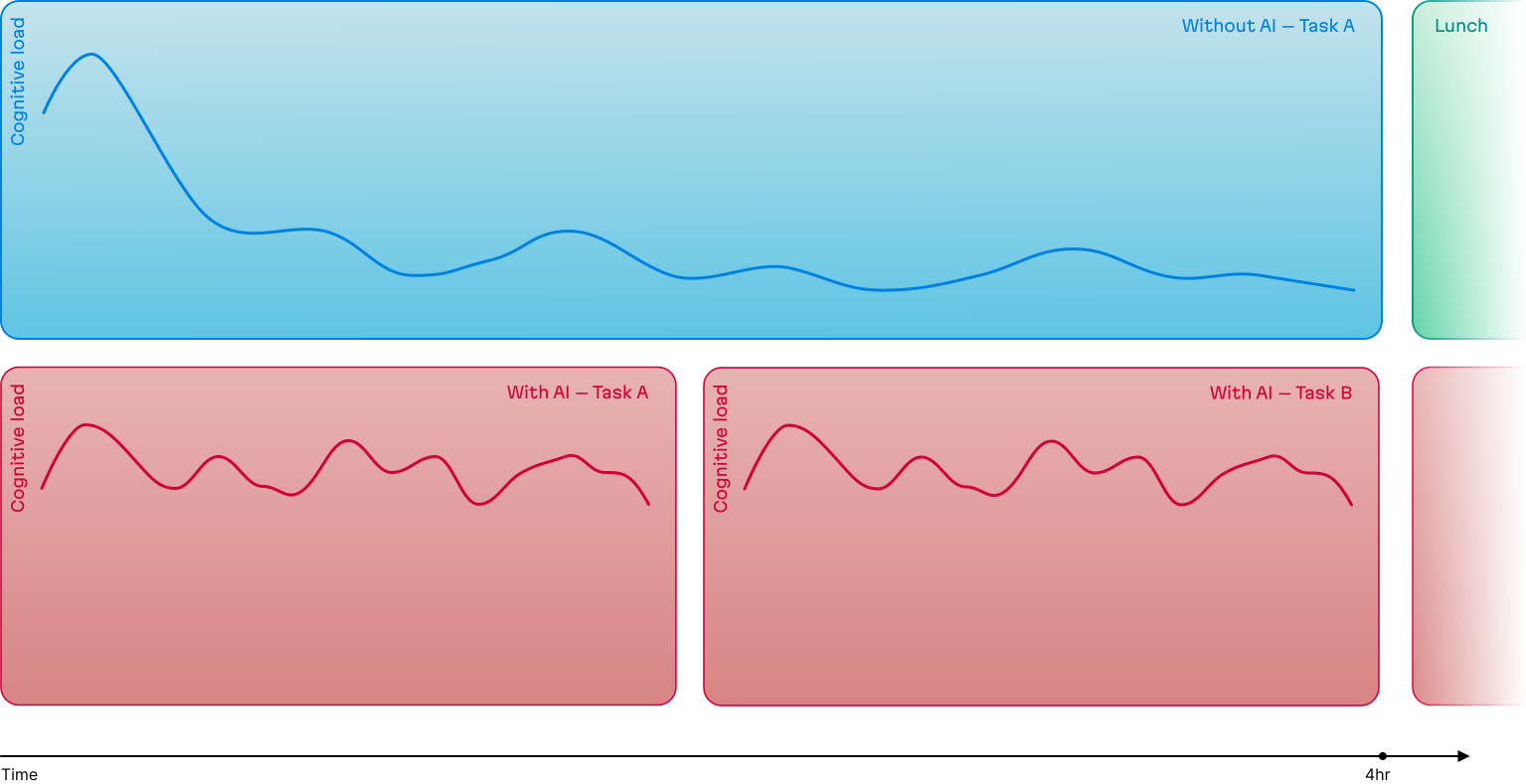
Ben worked longer, but did much less mental heavy-lifting, and his intellectual activity was distributed. He had to rethink parts of his architecture along the way, but in the end everything came together. It was challenging, but rewarding. A controlled marathon rather than a race.
Meanwhile, Alice was doing a high-intensity cognitive workout for 2 hours. She spent her time prompting, reviewing, and debugging–all cognitively demanding tasks.
Then, the key difference: after finishing, Ben stopped. He felt satisfied–he solved a real problem, understood the system, found the optimal solution, and had a sense of ownership.
Alice didn’t stop.
She finished early, but it didn’t feel like enough. In fact, she thought it “came easy,” even though it was cognitively harder. Maybe she even felt slow, as her expectations for her own work were unreasonably high–after all, the narrative tells her she should be a “10x engineer.”
So, she moved straight to the next task. Then, the next one.
Over the same 4-hour window:
- Ben did 1x steady, fulfilling work and went to have lunch
- Alice did 2x high-intensity, draining work
AI-assisted coding grows the workload exponentially–increasing both the amount of tasks and the intensity of work. In turn, AI-driven burnout is a result of three interdependent things happening simultaneously:
What we lose when AI writes the code
AI-driven burnout is a result of three interdependent things happening simultaneously:
- Less fulfillment generated by work process
- Higher intensity of work
- Greater quantity of work

Programming before AI
The cycle of planning → crafting → result is being disrupted. When we use LLMs, we skip from planning and go straight to the result. We replace the enjoyable, meditative and tactile process of writing code with reviewing AI-generated code (which requires more mental effort and is more tiring).
So, we remove the part that we like, and replace it with a part that we really don’t.
Then, we speed this loop up and repeat it several times a day. There’s simply not much left in our work to be enjoyed. At the same time, pace and intensity go up.

AI-assisted programming
We compensate for a lack of satisfaction with work quantity.
Feelings of satisfaction used to come automatically when writing code. Now, ownership, achievement, pride–have been reduced or have disappeared completely.
We don’t live through the creative process like before, the connection to the result becomes weaker, so it gets harder to be proud of it. This creates the inclination to work more, since we don’t internalize the value of our work.
A quiet career change
People choose careers based on their interests for certain activities. Artists enjoy painting, not just exhibiting them. Writers enjoy writing, not just publishing or signing copies. And programmers enjoy programming! Not just deploying a product. But now, for many, the part of the profession that attracted them in the first place is being removed or fundamentally altered.
If we stare into a crystal ball for a bit we might see a potential future: the AI-first approach transforms the ecosystem so much that engineering functions can be performed sufficiently by non-technical roles (plus design, product management, and so on). Reliance on narrow specialists decreases. The entire scope of product creation and maintenance is handled by jack-of-all-trade “AI generalists”.
But we’re not there yet! Our job title remains the same. Roles and grades are the same as two years ago. Yet the structure of the work is already changing so much that it can feel like a different profession. We find ourselves in a peculiar situation: without consciously deciding to change careers, we’re quietly making that transition. There are essentially four paths forward:
- Find ways to enjoy this new kind of work and evolve with it.
- Ignore AI and keep working like it doesn’t exist.
- Work with AI but without enjoyment, hoping for a return to the good old days, when our responsibilities and professional identity were closely tied to craftsmanship.
- Change careers; find another field of interest, less affected by AI.
Obviously, the first option is preferable, the second is denial, and the third is not sustainable. A radical career change goes beyond the scope of this article, so we should focus on the first option–avoiding burnout and relearning how to appreciate the profession in its new form.
Daily reasons contributing to burnout
Before moving to solutions, let’s review other daily factors for developers that have appeared with the adoption of AI workflows that are also adding to our burnout meters.
Losing context
When you work with an agent, as it gets more context, you lose it. You stop needing to hold the project in your head: the architecture, the edge cases, the reasoning behind past decisions–it all starts living outside of you.
You not only delegate writing the code, but actually understanding your system.
This extraction creates a subtle but serious problem. This is because the deeper your engagement with a codebase, the better your judgment. You spot problems before they become bugs. You recognize the shortcuts that will cost you later. You understand its problems, not just intellectually, but intuitively. That intuition is built through immersion–and agentic workflows erase it.
This also cascades to the team and onboarding. You can’t teach or review what you’ve never learned. Over time, you become a supervisor of a project you no longer truly know. And supervising something you don’t understand is exhausting.
No time for passive thinking
When solving a problem the traditional way, a lot of thinking happens unconsciously. This goes on in the background as you experiment with code, or even while you’re away from the screen: on a walk, in the shower, or half-asleep. It’s one of the ways your brain processes hard problems.
With AI, we’re losing this critical part of the problem-solving process. Planning collapses into a few minutes of back-and-forth with a model, replacing actual thinking with agreeing or disagreeing with its proposals.
The model fills the silence before your own thinking has a chance to connect dots.
As a result, you make seemingly fine, but objectively non-optimal decisions → generate imprecise code on top of it → realize the weakness later in the process → feel the need to start over or rework the entire thing.
False expectations
Starting to work on a project with AI assistance creates a false sense of euphoria. Features appear, progress seems easy, you pick up one task after the other.
But this creates a trap. Both yourself and your clients (or managers) set expectations upon that pace. This sprint becomes the baseline expectation. When the inevitable slowdown comes, you find yourself struggling to re-reach that bar.
Review bottlenecks
With agents, often, the volume of generated code often far exceeds what one person could reasonably review. Agentic coding speeds up typing (which, by the way, was never the slow part to begin with). But with that, it removes the bottleneck on introduced errors, bugs, and poor decisions.
People feel less responsible for AI-generated code. Some don’t look at it at all, passing it directly to whoever holds quality standards on the team.
The more code is generated, the more code needs to be reviewed.
That reviewer (often a senior engineer) must now absorb a disproportionate share of risk, stress, and cognitive load. They’re trying to maintain system sanity, best practices, and codebase quality standards–while being hit by thousands of lines of (at best) mediocre code that nobody else has read.
Endless possibilities
When writing code by hand, the effort of each new direction acted as a built-in scoping mechanism. Trying another approach was more costly, so you’d weigh carefully whether it was worth it.
With AI, this friction is mostly gone. Every new idea costs only a prompt.
This opens a world of possibilities but it’s easy to get carried away exploring them.
Seemingly cheap iterations can accumulate, and by the time you notice how long you’ve been at it, you’ve already passed the point where stopping would have made sense.

Self-help action items
So, is this all fine? It doesn’t have to be this way. Below, you’ll find a list of practical advice: work practices you can apply today to improve your relationship with AI-enabled workflows and keep your burnout meters under control. Start with the ones that respond to a sentiment that feels the most relevant.
How to stop AI burnout ⚕️
-
Raise awareness of the value that you bring and become proud of your work.
-
Work with AI agents in a way that they help you instead of augmenting fatigue.
-
Reconnect with the enjoyable part of work.
-
Discipline and work-life-balance
Plan your work hours and remember to take breaks.
-
Find new areas of interest in your work
Explore new skills for your evolving role.
Acknowledge your wins
😐 I have a weak sense of achievement. I take no pride in my work. It doesn’t feel like enough. It doesn’t even feel truly mine.
If any of the statements above resonate with your inner world, you need to be more aware of the value that you bring! This makes you associate deeper with your work and feel better about it:
- Adjust your thinking. AI may generate the code, but you still do the work. As explored in the Math section, you’re probably working harder than you used to–you have the right to be proud.
- Keep a win-log. Note every task you complete during the day. If your organization has a channel to share wins with your peers, do that regularly too. (If it doesn’t, you can propose one.) For instance, at Evil Martians, our team has a very active win channel and it’s always great to see our team members shouting each other out.
- Demo the results of your work to your teammates. Present your work to your manager or your peers. Share your screen, walk them through what you’re building. This is also a regular practice for our team.
- Track hours. This can also be beneficial as a part of work-life balance control. But even more importantly, tracking time gives you measurable, visible blocks of the work you’re doing.
Rethink your AI workflow
🤷 AI isn’t helpful, the process is exhausting, it would be more efficient to code by hand.
If this sounds like you, try adding some rules to control and improve the way you use agents:
- Plan more, review less. Always start with “plan” mode. Read it. Fix errors in plan before they become code. Perfect scenario: try and get a valid result in one iteration.
- Don’t spend too long trying to make it work. If you can’t get a good result after 3-4 steps, start over. Try a different approach.
- Don’t work on multiple tasks in parallel. Now that generating code feels easy, it’s tempting to pick up more than one task at a time. But it’s a trap. It adds mental strain and debt you’ll need to come back to. Plan a clear checkpoint and don’t switch until you get there.
- Don’t work on two AI-heavy tasks in a row. AI can feel addictive at times, and it’s easy to start going from one task straight into the other. It doesn’t let your mind recover. A good practice is to let your brain relax a bit after each agentic task you complete.
- Decompose tasks. AI can generate hundreds of lines in one prompt, so breaking down tasks may feel less necessary than with human developers. But in reality the mental load of large tasks doesn’t disappear–it’s only offset to a later stage. Also, working on large tasks, it’s easier to get caught up, not take breaks, etc.
Keep exercising your craft
😔 My work is becoming too synthetic. I liked how coding used to be and I miss it.
Don’t use AI all the time. You can still do some good ol’ coding work from time to time.
- Protect “craft” hours or tasks. Take some time off from AI. Select some time in a day or specific tasks where you won’t code with agents. These don’t have to be the hardest tasks that AI “can’t handle”; this isn’t about maximizing your productivity. Do it to reconnect with the quiet, enjoyable part of your work.
- Know when not to use agents. Don’t just default to using AI for everything. There are some tasks where use of agents is beneficial: boring tasks, ones where you know AI is guaranteed to give you a noticeable efficiency boost, or simply those that you don’t want to do yourself. But for the tasks that you enjoy, keep them to yourself.
- Use “Ask” mode. Leverage the model itself to navigate the unfamiliar codebase. Use this to assist and advise you when needed, not for generating the implementation.
- Don’t use AI for passion projects. If you’re building a pet project, abstain from using agents there (more than you want to, anyway). You’re doing it on your own time, there are no deadlines–in other words, the perfect opportunity to enjoy the process in a way you’re truly passionate about.
Discipline and work-life balance
I’m working too much, at the end of the day I don’t have time or energy for anything else.
Plan the day and commit to follow it.
- Plan your work hours. Do not work outside of them; stop mid-feature if you have to. (This plays well with tracking your hours.)
- Take regular proper breaks. This is especially important now, since your brain can always be working hard, and doesn’t get a natural chance to recharge during coding sessions.
- Plan your intention for the day. Stop once done. If you complete everything ahead of the schedule, don’t fill it with further hard work. Instead, dedicate this time to communicating, learning, cleanup, or some other “soft” task.
Find new areas of interest in your work
😵💫 My role is starting to feel like a different profession and I don’t like what it’s becoming.
As explored in the Quiet career change section, this feeling is justified. The fact is: this profession is changing. And we should look for new ways to appreciate this new form. Here are some relevant areas and skills where you can seek satisfaction:
- Work with users, interviews, feedback loops, identifying real needs.
- Focus on communication and soft skills.
- Explore analytics, prototyping and hypothesis testing.
- Learn to fine-tune agents and set up guardrails to make “vibe coding” sustainable.
- Get good at performance optimization.
Epilogue
In these times of uncertainty, it’s utterly important to distinguish between the reality and the marketing narrative. The tension between these is where a lot of unnecessary pressure originates.
That said, AI is changing our reality, and–whether we like it or not–it’s here to stay. That part is beyond our control. But what is in our control is how we approach work, where we set our boundaries, and what we choose to believe.
AI can be helpful. Problems appear only if you misuse it.
Slow down. Touch grass. Set sustainable expectations. Learn to use AI to help you, not overwhelm you. Find the little things that you like. Notice them. Remember why you chose this profession and reconnect with it.
The industry will figure itself out eventually. Your job is to make it there with your energy, your curiosity, and your ability to enjoy work still intact.