

What we talked about
From chemical engineering to multiplying yourself
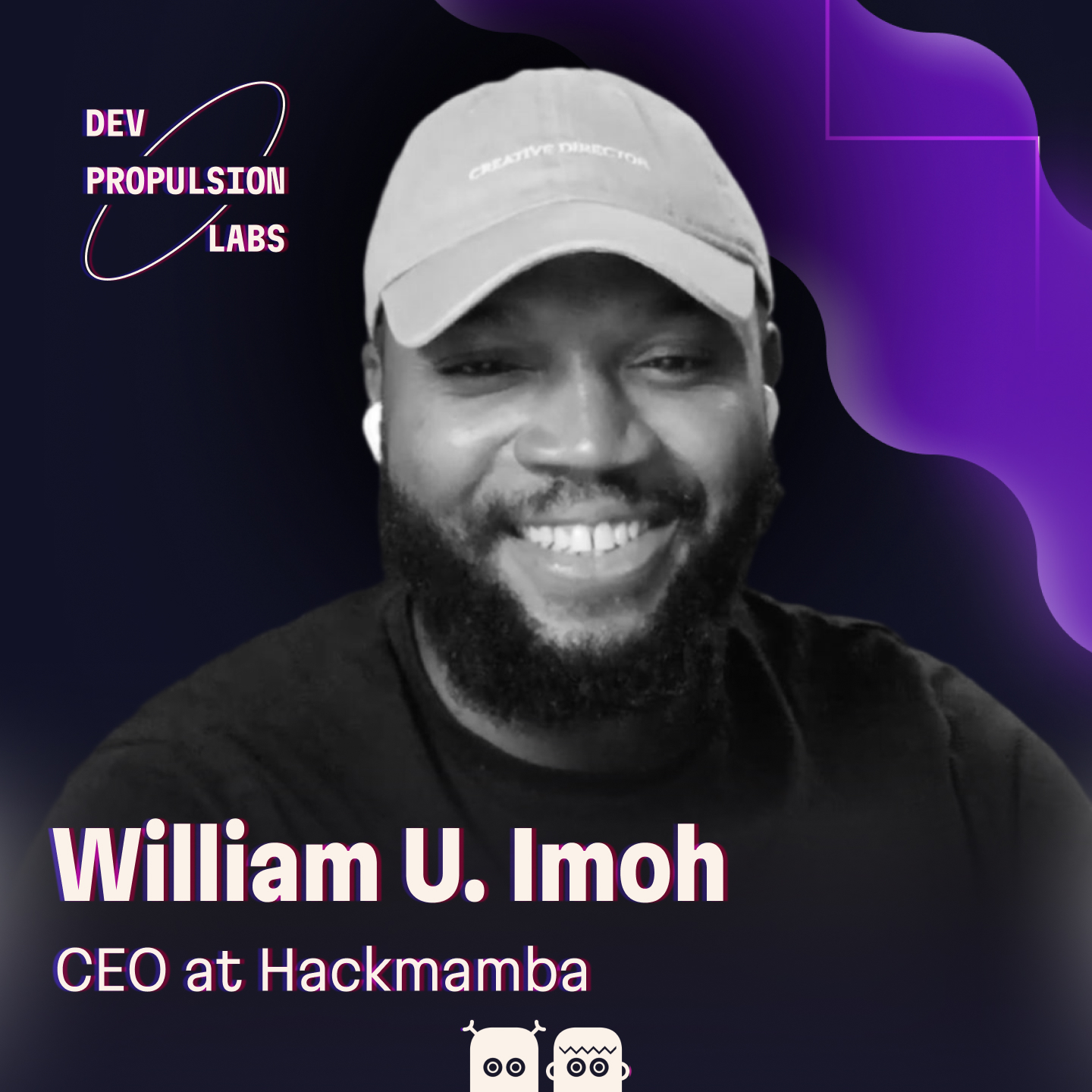
William has a chemical engineering degree, taught himself software engineering, discovered he was good at explaining things, and became a developer advocate. As a part-time freelancer with a day job as a technical product manager, his clients kept asking for more content, because he was a developer who could sell. Ten articles a month was the ceiling, so he started Hackmamba to multiply himself: find other engineers who want to sell, can write, and care about quality.
What “good writing for developers” actually means
When Hackmamba started, great developer content meant bottom-of-funnel tutorials showing the product inside a real problem space, like building a Netflix clone to demonstrate media management at scale. Top-of-funnel SEO was left to regular marketers, until teams realized those pieces needed technical depth too. Every brief names who it’s for and, in William’s words, why they should give a shit. The non-negotiable: every creator must have an engineering background, because in this space a wrong fact gets posted on Twitter by a competitor and you’re cooked.
The strong suggestion
Hackmamba never pitches the product directly in a piece. The product is always a “strong suggestion” — which means they’re not afraid to discuss a competitor, as long as they’re objective about it. For mid-funnel comparison posts, depth is the whole game: the reader already knows the basics, so the team actually uses the product and answers what a senior engineer tasked with picking a vector database would genuinely care about.
AEO is what good SEO looks like after ten years
Asked what changed now that everyone optimizes for LLMs, William gives the answer that doesn’t sell: not a lot. He recounts asking Matt Biilmann, CEO of Netlify, how they generate 30 to 50 thousand signups a day mostly from ChatGPT and AI referrals. The answer was “we’re not doing anything” — ten years of product, brand, community content, SEO, customer stories, open source contributions, and developers vouching for them on Reddit and at events, all compounding. Hackmamba sees the same thing, and in some cases has gone back to SEO fundamentals: right keywords, real answers, E-E-A-T and author authority, optimized headers, and small things like image alt text and filenames, since the AI engines crawl images too.
The two things that did change: perception and value measurement
Write the way Hackmamba wrote in 2021 and it now reads as AI slop, which is fair, since that content probably trained the models. The evolution is stronger opinions and expert insight as a non-negotiable: the one thing AI systems don’t have is a personal experience, something that happened to you at work yesterday. The second shift is time. Teams used to wait a month for a piece. Now if GitHub goes down, the reactive post needs to exist tomorrow morning. AEO metrics are showing up in marketing KPIs, though William still tracks referral traffic directly in analytics rather than trusting the citation-tracking tools, which he doesn’t find deterministic enough.
Champion versus buyer, and killing your own traffic
Hackmamba sells to CMOs and heads of marketing while individual developer marketers raise their hands, and their clients’ customers are developers. The usual split is LinkedIn or X for the buyer and the blog for the champion, since the blog sits closer to the product while the buyer cares about brand and outcomes. Podcasts and YouTube skew to buyers for the same reason. Hackmamba learned this on itself: most traffic was coming from developers who didn’t care what the company did, so they killed that content. Traffic tanked. They briefly tried to keep some developer content for the feel-good of the numbers, then bit the bullet. For companies selling to CTOs, William’s advice is proof over volume — compact case studies pushed to socials.
Titles, headings, and researching what already works
A good title depends on the outcome the piece delivers and the funnel stage it sits in, and Hackmamba writes it after the body exists. Top-of-funnel titles avoid branded terms entirely and stay close to search intent. For social, William suggests asking Grok which articles in a niche went viral in the last month, then reading the common themes in their titles and structure. Section headings should come from real sales objections, support questions, FAQs, Google Search Console queries, or the headings competitors already rank for — with correct hierarchy, so an H3 never contains an H2.
The LLM optimization skill, and what’s in it
Hackmamba maintains a skill it constantly updates, but the core has always been the same: a TLDR, the core question answered in the first paragraph, supporting questions across sections, and every chunk carrying a self-contained, meaningful piece of information. A clear CTA and correct semantic structure round it out. William notes they wrote this way by default before anyone needed a skill for it, and that FAQ blocks have been inconclusive — sometimes they work, sometimes they don’t.
Distribution from day one
For early-stage teams, strategy, production, distribution, and social engagement all start together. Hackmamba checks messaging and positioning first (developers respond to novelty, so where is it?), researches gaps competitors haven’t covered, and builds a hub-and-spoke model of pillar content plus satellites. Someone owns distribution: Reddit, X, LinkedIn, dev.to, Medium, Substack, X articles, plus LinkedIn groups, Discord, Telegram, and Slack channels — carefully, since admins get jarred. Crucially, they don’t drop links. Each channel gets a summary or 400 words that stands alone as content, with the long-form piece expanding on it. The target is 30 to 50 thousand organic impressions a month per client. Newsletters get sponsored through Paved, and they keep a handful of four or five cross-channel influencers rather than large lists, saving those for launches.
AI as electricity, and building Boki
William frames AI as a force multiplier, like electricity: you can cut your lawn with a knife, but a powered mower is faster. The constraint was scaling without hiring hundreds of people, so they set a deliberately crazy goal — take content production from a month to a week — while holding quality constant. The problem was fragmentation: Linear, Dropbox Paper, Grammarly, Buffer, Semrush, Surfer SEO, Google Sheets, and Bitly, minimum seven tools to ship four pieces a month, with knowledge scattered across all of them. Bolting Claude on top just made it the eighth. So they built Boki, cancelling each subscription first and finishing the build second, so there was no way back. Kanban, a collaborative editor (William doffs his hat to Google Docs on this one), campaign plans that live next to the content, a social scheduler, a link shortener, and expert insights: an email request you open and just talk into, captured by speech-to-text.
Building a GTM company model: context, orchestrator, skills, memory, models
Only once the modules existed did they add the agent — LangGraph as the framework, Mem0 for memory, skills written up from Notion and tribal knowledge into a GitHub repo that bundles as a package, and an MCP exposed so Boki can pull from Ahrefs, Gong, or anything else. William’s advice for anyone building something similar, in order: context first, since scattered context is the actual problem; then an orchestrator or harness, which is also your interface and where the human stays in the loop; then skills and instructions, which matter less as models get smarter but are how you inject your own opinion; then memory, which for organic marketing barely matters because anything three weeks old is obsolete; and finally models, using the smartest available for generation and something lighter for menial work.
The warm fuzzy
William says he feels like a shark in water most days, except the ones where he loses a deal. What he likes is putting every skill to use at once — being a developer, speaking developer, and marketing properly — and driving transformation that he can actually deliver: “You don’t wish it into existence. You can work it into existence.”
Transcript:
[00:00:00] Victoria Melnikova: Hi, everyone, and welcome to Dev Propulsion Labs, our podcast about the business of developer tools. I’m your host, Victoria Melnikova, and I’m here with William Imoh, founder and CEO of Hackmamba. So hi, William, welcome to the show, and I’m really excited to have you here today. How are you?
[00:00:22] William Imoh: Yeah, I’m doing great. Thanks, Victoria, and thanks for having me. Always excited to talk about developer marketing and, yeah, the business of helping developers get value out of dev tool products.
[00:00:32] Victoria Melnikova: So let’s talk about your business. We’ll start right with that. Hackmamba does go-to-market tech marketing, developer marketing for startups, right? For developer-facing companies. Tell me more about Hackmamba and what was your journey? How did you get started with that?
[00:00:51] William Imoh: I basically have a chemical engineering major, like a chemical engineering degree. After that, I decided to teach myself software engineering. I did that for a bit. I figured out that I could teach people. I was good with talking and writing articles, so I became a developer advocate. While I was doing that, as a freelancer, my clients kept asking for more content because I was a developer that could sell. So I decided at some point that, hey, I think I’m unable to write over ten articles a month, which was what I was doing then as a freelancer. And this was part-time, ‘cause I had a job as a technical product manager.
So I decided to start a company to multiply myself. Basically, find other people like myself that are good engineers, that wanna sell, and they can write, and they care about really high-quality content. That was how Hackmamba started.
[00:01:51] Victoria Melnikova: So when we talk about good writing for developers, what does it mean exactly? Because in my experience, it’s not necessarily what is good writing on consumer products, for example. So what’s your take on what it means to do good writing for engineers?
[00:02:10] William Imoh: When we started, great content for developers meant mostly bottom-of-funnel pieces, and these were mostly tutorials, content that showed how to use the product within context of either certain business verticals or certain problem spaces.
For instance, how to build a Netflix clone, because you’re trying to show how you can handle media management at scale, at Netflix scale, right? So that was sort of like the kinds of content we wrote majorly. And the very top-of-funnel SEO pieces, those were left for regular marketers. But over time, teams started to find out that they needed a bit more technical depth in the top-of-funnel pieces.
So this is where developers came in. Now, we needed to find a perfect blend, a way for us to teach first and then sell secondly. So what we did, which was great in that time, is, and also meet SEO requirements, because the content had to be discovered. What we did in that time was we would have the full SEO requirements we needed to satisfy.
We would create a content brief that had, like, who we are writing for. We usually say why they should give a shit. We write it that way in the brief. So why should anyone care about this? What’s the outcome for a developer? And we’re able to clearly articulate why anyone should care because we are developers ourselves.
So we look at it and say, like, “Am I gonna care about this thing or not?” We go over, like, what call to action should look like. Because we’re marketers, we think about things like backlinks and other contributing sources that we needed to consider. Now, while writing, we ensured we didn’t talk about the product in any way directly.
So we always passively sold the product. At Hackmamba, and we still do, we adopt a system that we call a strong suggestion, right? So the product is always a strong suggestion when we write. This means we are not afraid to talk about a competitor, but we just need to be objective about it, so also we don’t get sued.
But yeah, we’ve always adopted the make a passively strong suggestion about the product in the content. So this is how we wrote top-of-funnel pieces. For mid-funnel pieces, these were basically straightforward. We’re reaching out to the user when they are comparing multiple solutions, and comparative posts in this case differs from how you would write it for a consumer product.
For this, it needed to be deep, because the person you’re writing for, the audience you’re writing for, they already know a lot of the basic stuff. So we needed to use the product, and then we needed to also answer the question: if a developer, a senior developer that cares about, or who’s been tasked to go find a vector database solution, was to stumble across this article, what exactly are they gonna care about?
Right? So there was always the need to go as deep as possible and be very objective about it. Because again, our space, it’s very easy to name and shame. So you write an article, you don’t go deep enough, and you state facts that are wrong, your competitor will just put it out on Twitter and you’re cooked, right?
So we always needed to get the facts right while still optimizing for SEO. This meant that the writers had to be engineers. That was something we couldn’t compromise on, that every creator must have an engineering background. This should come from, like, our initial thesis that I had as well. So that was how we approached content differently when we wrote.
[00:05:44] Victoria Melnikova: Mm-hmm. That’s very interesting, and in five years, since 2021, a lot of things changed. The notion of SEO changed, right? Like now we’re talking about AI optimization, whatnot, LLM optimization. Has anything changed drastically in your experience, or still the same kind of basic hygiene that you would apply to SEO still stands today?
[00:06:12] William Imoh: Yeah. So not a lot has changed, right? And this doesn’t sell. Like saying this doesn’t really sell. But in the spirit of being honest, not a lot has changed. What we see today as AEO or AI search optimization is as a result of great SEO work. I spoke to Matt Biilmann, the CEO of Netlify, some weeks back at an event, and he was talking about how Netlify generates anywhere from 30 to 50K signups a day.
And obviously, the next question would be, “Hey man, what are you guys doing?” He’s like, “Most of the searches or most of the signups come from ChatGPT and AI referrals.” So obviously I’m like, “So what are you guys using? What tools? What techniques?” ‘Cause I wanna be able to sell that too, right? And he says the thing I was expecting.
“We’re not doing anything. This is just from the last 10 years of building a great product, building a great brand, generating a lot of community content, doing a lot of SEO content, having great customer stories and great proof. Having a lot of proof as well, so a lot of developers talking about us on Reddit, at events, being at events, being in forums, contributing a lot to open source, being a part of other developers’ careers.”
So we have some great developers and developer advocates that have worked at Netlify, them bringing that credibility also. That’s all what’s compounded now. So they’re not doing any fancy AEO magic. And we’ve seen the same at Hackmamba, is that when we do great work with SEO, actually in some cases we’re having to go back to SEO fundamentals, right?
Ensuring that we have the right keywords. We’re answering the right questions. We’re caring about E-E-A-T, so authority on who’s writing the content. We’re optimizing the individual headers as well. We’re adding images, the right images, and we’re caring about little things like the alt texts for the images, the name of the images as well, because these AI engines will crawl both the images and the content as well.
So not a lot has changed, but obviously what’s mostly changed are two things. It’s perception and value measurement, right? The first, perception — that’s one thing we didn’t expect — is the way we wrote in 2021, if we write that way today, it’s gonna be counted as AI slop. And that’s understandable, because all the content that we wrote then were likely used to train the models that we use today.
If we write in the same way, this is like, “Nah, this is just slop.” So we had to evolve how we wrote over time, and we had to introduce different, not tricks even, but I’ll call them evolutions. We needed to have stronger opinions. We saw expert insights as non-negotiables, for instance. We thought about what’s the one thing AI systems do not have that we do, and that’s a personal experience.
That’s an opinion. Something happened to you at work yesterday. Something never happened to an AI model at work yesterday. So that’s a difference that we can bring into content. And a lot of marketing is feelings and perception and how people feel about a product and how people feel about the content they read.
So we’re looking at marketing from that lens now, even developer marketing. So perception, that’s one thing that’s changed and has shaped how we create content now. The other thing that has changed, obviously, is value measurement, right? Previously, for an agency, teams were patient enough to have us create content in a month, because we needed to spend time with research, putting content together, editing it, going through multiple passes.
With AI, that’s changed. Everyone wants the content yesterday. People are a lot more reactive this time around, right? If news breaks today, if GitHub is down and someone wants to write, maybe, a site reliability post around how to manage systems like GitHub so they don’t fail, they need to be able to react to it like tomorrow morning.
There’s no “we’re gonna write a post for it next week.” So the way teams see value has changed in terms of time. And then in terms of business outcomes, that’s also changed, with a lot of teams now having AI overview or having some AEO metric as part of their marketing KPI. So how much traffic are they generating from AI mentions and AI citations?
Are those tangible? I’m unsure. For us, we track referrals directly in the analytics tools. We still don’t use any of the Profounds or Peecs or Promptwatch or all the other tools that are out there, because from an engineering perspective, they haven’t been deterministic enough for us. That’s a strong opinion I still hold.
This doesn’t mean that we aren’t keeping an eye on how we’re showing up in AI searches, but right now we’re just looking at referral traffic directly in the analytics tool to see what’s hitting our landing page, not what is being cited in ChatGPT.
[00:11:39] Victoria Melnikova: That’s very interesting and it resonates with me on so many levels. And as you speak, I’m like, “Oh, I have this question I want to ask, this…” Too many questions. Because I lead marketing at Evil Martians, so we ourselves face a lot of those challenges, and I kind of want to have this, like, expert Q&A with you and hear your opinion on something. So, for example, and I think that a lot of dev tools also struggle with this. Let’s take Evil Martians.
We have a big blog that’s well-respected amongst the engineering community. We have about half a million readers every year. So a lot of engineers read our blog and get some guidance from it. But our ICP is actually CTO or technical co-founder. So there is that bridge between who we market to in our blog and ultimately who’s gonna be our buyer, right?
And I’m sure a lot of developer-facing products face the same issue. It’s kind of like you have the champion, who is an engineer, but the buyer is a founder or a CTO. So we ourselves fiddle with content for CTOs. We try to make valuable content for CTOs as well. How do you see that resolved? Like, should those two marketing channels be kind of compound, or should we not even bother, right, for CTOs, because those are kind of busy people and the blog is for engineers and…
What’s your overall stance on the strategy when it comes to that question?
[00:13:18] William Imoh: So we’re in a similar spot, right? We have CMOs and heads of marketing buying from us, but we’d have individual developer marketers be, like, hand raisers. And not just that, our customers’ customers are developers, so.
We started out creating content for developers initially, but we soon quickly realized — actually, we realized about a year or two ago — a lot of our traffic came from developers who didn’t really care about what Hackmamba did or does. So we had to switch to just focus on creating content for developer marketers generally and who our buyers are.
For our clients, though, we always have to strike a balance, right? And identify the folks in their buying committee, typically. If we should be creating content for developers, or maybe we have a channel focused on developers and a second channel focused on their buyers, right? So a lot of folks do either they have LinkedIn for the buyer, and then they have the blog for the champion, because the blog sits closer to the product that will be used and be tested, whereas the buyer cares more about the brand and the outcomes you talk about delivering.
So we pick either X or LinkedIn, depending on the kind of buyer, and we have that channel for the buyer, and the blog or other channels we keep for the champion or influencers on the team. Same thing too with podcasts or YouTube videos. We’ll want to keep those for the buyers, because that’s also a way from — it’s closer to the brand, but away from the product in a way, whereas the blog is, you know, a lot closer to the product.
So that’s how I would see that distinction. Now, in your case, where you are selling to CTOs, that’s a bit tricky. The last time we worked with a company that sold to CTOs, like a dev agency, a really big one, what worked for them was mostly just showing proof. So we just focused on creating a lot of case studies and putting those on socials mostly, making the case studies compact enough, and not caring about developer content.
In your case, I would expect that you don’t care about volume. Our major traffic drivers were coming from a wrong audience. Now, a lot of traffic is great. It’s great on paper, right? And everyone panics when traffic is dropping. But we needed to bite the bullet and say, “This is just not good traffic.” This traffic’s coming from blogs that I can see I wrote as a developer for developers, and these developers are definitely not selling our product.
Like, they have no incentive to do so. So we just deprioritized those. Traffic obviously tanked. At a point we wanted to lie to ourselves. We’re like, “You know, we think we can do both. We’re gonna keep some developer content coming so we can enjoy the hope of the traffic. We can enjoy the feel-goodness of it.”
But at some point we’re like, “Nah, this is not gonna work.” So we killed that and we just went onto our niche, focusing on the champions that we’re working with, doubling down on proof because we’re an agency. So it was just we wanted to show proof, create with quality, and create consistently. So this has been our growth strategy internally for the last, I think, two years now.
There’s show as much as possible, and then the last bit was branded and co-marketing events. I guess that’s why I’m on this podcast as well, is talk to other people within the niche that have complementary products or complementary services, and that’s a channel that worked for us, partnerships.
So that’s been our strategy. We’re still creating great content, but just not directly for developers now.
[00:17:18] Victoria Melnikova: Mm-hmm. Yeah. That makes a lot of sense. I also wanted to address another point that you brought up a little bit earlier, headings for articles. ‘Cause for us internally, again, it’s very important to write good articles, and a lot of the times title becomes like a matter of discussion between us internally.
How would you define a good article title? And also, to your previous point, you talked about social proof. We try to bring social proof into the title of the article somehow, maybe numbers, maybe some names of customers that we worked with or whatever. What’s your overall recommendation? Like, what’s a good article title?
[00:18:07] William Imoh: So a good article title depends on the outcome that you’ve stated, right? So a lot of times our article titles are also like strong suggestions, and we modify it after we’ve written the content. So we have the brief. We already sort of directionally know where the title is gonna go. The creator writes the body of the content.
Now we get a sense of, like, here’s what we’re imparting, the knowledge we’re imparting on a reader. And from this, we can work on the title. Now, the header typically depends on what funnel stage the content is gonna fall under. If it’s top of funnel, we avoid any branded terms in there. So nothing about Evil Martians, for instance.
We like to keep it very close to the intent a user would search for, again, because it is top of funnel. If we’re expecting that this content is gonna be educational, it has to be that as well. It has to be a what, a how, or where, or when kind of article, right? So that’s how we would phrase it. If it’s a comparison article, it also has to match the intent as close as possible.
For every article, we conduct extensive research to see what people are talking about there. So that’s non-negotiable. We use Boki internally for that. For research, you can use Ahrefs or you can use Semrush, right? To figure out what are people talking about? What’s the opportunity here? And the headline should be close to that.
If it’s a social piece, then you need to understand the social dynamics of wherever you’re posting it into figure what’s working today. Is it like some clickbaity title? On Twitter, writing “We killed Google” for a long time, at least a couple weeks ago, worked, right? Now if you put that, that’s just clickbait.
So also seeing what works on social channels if it’s for socials. A good hack that we use at the moment — I wouldn’t call it a hack, I would expect a lot of people would know it — would be to use Grok. If you’re gonna post it on Twitter, ask Grok like, “Hey, what are the top 10 articles that have been written in this category or within this niche that have gone viral in the last month?”
It will pull that up. You would already get a feel of, like, here are some common themes there, and you can ask Grok to go over them, figure out what are common themes with the titles for each of them, and also the structure of the content, what’s common across them. That would give you a sense of, like, my title has to lean that way.
For the individual titles in the content, now this depends again on your outcomes. If you’re writing it to answer — if it’s bottom of funnel, you want them to match objections you’ve heard from sales calls or stuff that your customer support team has cited. Or it could be questions that you would traditionally use in FAQs.
If you’re using an AEO tool to track what people are asking for, or on Google Search Console you’ve seen some of the bottom-of-funnel queries there, you can tailor those headings there. You could also get the headings your competitors are ranking for. So on Boki, we see all the individual titles ranking for a particular bottom-of-funnel keyword.
We can see the different headings that these articles have, and the goal obviously is to surpass that. So that’s how we handle headings in the content. And for those headings, you wanna ensure hierarchically they are correct. So you have H1s, H2s, H3s, and you never have a higher header being under a lower header, right?
You never wanna have an H2 be within an H3. It’s the other way around. So it makes sense for indexers.
[00:22:05] Victoria Melnikova: Do you do anything special for LLM optimization as far as semantics go? Like, for example, we have a skill that allows you to optimize for LLMs, right? Like something that we’ve acquired over this year that we think works.
Do you have any guide or any skill that you guys use internally to kind of run through the final draft to make sure it’s ready for LLMs to be picked up?
[00:22:31] William Imoh: Yeah, we do have that skill. We’re always constantly updating it with what we see is working or not. But the core things have always been having a TLDR, answering the core question in the first paragraph, having supporting questions in different sections, writing the content in a way that every block, like every chunk, passes a meaningful piece of information, and it can be self-contained.
But that’s how we write by default before. We didn’t need a skill to write that way, especially technical content. Having a clear CTA, semantically structuring it, like I said, so that you don’t have an H2 being under an H3, which is also pretty normal. So those are some of the ways. We’ve experimented with having FAQs in the content.
Sometimes it works, sometimes it doesn’t. So it’s not like that one hasn’t been very definitive for us.
[00:23:37] Victoria Melnikova: Another big question before we dive into a bigger topic of AI, because I kinda want to sit there for a second. Before we dive in, though, do you guys work on developing distribution channels? Is distribution something that you could recommend?
Like, let’s say you have an early-stage dev tool startup that comes to you, and they have nothing. No blog, no social media, no nothing. Would you build the strategy including the distribution channels, or would you just focus on the content and have that organically evolve? Like, what’s your strategy overall?
[00:24:16] William Imoh: So when teams come to us now, especially when they’re super early, it’s almost a given that we do strategy, content production, and distribution from day one, right? And part of distribution is social engagements. So I’ll put social engagement as sort of the fourth thing.
We work on their strategy, so just checking messaging and positioning. Is it right? Are they gonna make it or not? Do they have a novel product? Where’s the novelty in their product as well? Because for developers, a lot of it is just novelty. So we go over that, and then we put together content research, figure out what gaps currently are in the market, where their competitors are currently not playing or haven’t covered yet, what a beachhead looks like for them in terms of content.
At the end of the day, we end up with multiple hubs, so we use a hub-and-spoke model. We have multiple hubs with individual spokes, so pillar content and all the smaller pieces around it. We go from that to generating the individual titles and briefs for the content. We go through creating the content, and after that, we have someone in charge of distribution, whose job is to get the content into all the relevant places.
On Boki, we track social mentions and keywords for every partner. So part of onboarding is setting that up as well and seeing where the content we create, where we can distribute it into. So as part of distribution, we would typically put it on Reddit, X, LinkedIn. We could repurpose it for dev.to or Medium, depending on the audience.
We could also put it on Substack as well, depending on the kind of content. In some cases, we can make an X article for it if it’s that kind of opinionated piece. Then we also look into certain LinkedIn groups, Discord, Telegram channels, some unique Slack channels, just putting the pieces in there.
Those are a little bit sensitive because the admins, they get very jarred when you post stuff in there. But the goal of that is that we’ve seen that for LLM citations or getting referrals from LLMs, those actually help. And when I say we repurpose it for these channels, we aren’t just taking the link and dropping it there and like, “Peace.”
No. It’s mostly like either a summary or 400 words about the piece and the core message from it. That’s what we put on that channel. So by itself, it is a piece of content, and the full, longer-form content just reinforces whatever, or expands on whatever has been said in the smaller repurposed piece.
So that’s how we take on distribution at the moment, and then we track everything. Our goal is usually to shoot for anywhere from 30 to 50K impressions a month per client when we work with them. And this is all organic impressions. They wanna go ham, we can get into PPC and, you know, doing some paid ads for them.
[00:27:37] Victoria Melnikova: Do you rely on newsletters at all or not so much?
[00:27:42] William Imoh: Yep, we do. We use newsletters. We use Paved. Yeah, if you’ve heard of Paved. So we use Paved to figure out what newsletters to sponsor. We also use influencers as well, but we don’t go large influencer lists anymore. We save those for product launches.
We work with a handful of, like, four or five influencers that can go across multiple channels as well. But Paved gives us the opportunity to mix and test out different newsletters to see what’s working from a conversion standpoint.
[00:28:16] Victoria Melnikova: Sounds really interesting. I hope people are taking notes as they listen to this, because…
It’s honestly kind of like being fit. Like, it sounds simple in practice, but when you start doing it, you need a certain system in place, you need consistency, you need a certain level of input that you’re putting in, you know? So I’m glad that you’re vocalizing those steps, because seemingly simple, it’s not that simple, especially when you’re doing it for multiple companies at the same time.
I want to talk about AI, and I’m curious to hear your position on this, because internally, we try to optimize and automate, especially routine things that don’t require a certain level of creativity or whatnot. And also another thing about us, we are just about fifty people, and everyone on the team writes articles.
And especially, as you mentioned, to create social proof pieces, we really need everyone to contribute. And sometimes we use AI to make things easier. Like, that sourcing of information from different kind of players is something that we use AI for internally, or auditing articles. Can you talk to me about your general stance on AI?
How do you guys use it? Are you able to automate a lot of things? Are you able to see good results with AI? Are you able to build agents or whatnot? Kind of walk me through what it’s like for you guys.
[00:29:52] William Imoh: I see AI as a force multiplier. I see it like electricity. That’s what I say to people, is you can mow your lawn with your hand, like cut it with a knife, but if you use the lawnmower, like a powered lawnmower, you do it faster, right?
You can light a candle here, and you’re still gonna see, but if you had electricity, you’d see even better. You’d have a lot more light. That’s how I see AI. But the key thing to note here is that there has to be a way to do it ordinarily. Obviously, electricity showed us ways to do things that we couldn’t even do before, right?
That’s also how I see AI. But for the things that we do at the moment, we had to find a way to figure out how can we multiply ourselves using AI without compromising on quality. ‘Cause we started Hackmamba, our thesis has always been, our mission is we’re gonna be authentic content creators for the world’s best developer tool and technology companies.
So how do we keep quality here, but then use AI to do everything else, right? So that never shifts. We approach it by a number of ways, but the first way was to set a crazy goal, right? A crazy goal to shrink operations. ‘Cause we’re like, okay, the one thing AI wouldn’t take from us is our creativity.
So creativity aside, what else is in the way? We’re gonna scale this business. If we’re gonna grow into a nine-figure, ten-figure business, we need to be able to scale without having to hire thousands of people in order to scale operations. We can keep creativity constant. So we went from picking out simple things like we spend a month creating content, we’re gonna shrink that down to a week.
Obviously, on the call, when you say that at first, everyone’s like, “What? How? That’s crazy. That’s not gonna work.” But that’s not how we see things. So we had to find a way to make it work. Last year, at the start of last year, I was thinking about this, and this was before AI became as crazy as we know it today.
We thought to build a system. I was thinking of sort of a GTM company model, right? Then we didn’t have Claude Code be mainstream, at least the way we know it now. We had Lovable and Bolt, vibe coding tools coming up. So we built Boki. It’s on boki.io, B-O-K-I dot io. And Boki was our answer to the scatteredness in operations.
To give you context as to the problem we had was, we had Linear for project management, we had Dropbox Paper for writing content, we had Grammarly for reviews, we had Buffer for scheduling content, we had Semrush at the time for some research, and then we used Google Sheets for a lot of tracking, right?
So across board, and there were a couple of other tools that we had as part of our stack, and this was likely to just create four pieces of content each month. We needed at least six different tools. It didn’t make any sense to me to do so.
So we decided to build Boki first. Another reason why it didn’t make sense was because knowledge was fragmented. I tried to use AI systems at that time, so tried to use Claude or ChatGPT. I was doing a lot of copy and paste multiple times, right? You can connect these tools to Claude, but then it’s not in a shared system, and you get like a chat.
I still wanted a nice editor. I wanted it to be collaborative so I can work with people. I wanted to track analytics as well. So adding Claude, like using Claude as sort of an AI system, I just made the tools instead of six, I made it seven. That’s what I had. So we decided to build Boki, which was our answer to a GTM company model, at least for organic marketers first, which is just a way for us to collect all context in one place and act accordingly, right?
So we wanted a system where we can go from research all the way to content distribution in one place with the context of the team, and a system that learns over time. So that’s why we built Boki. So today, we have to do this without relying on AI to generate content, right? This was when everyone was starting to generate content with AI.
So our first thesis was we’re gonna build this, but we would not generate content on Boki. We’re gonna try to do everything else, right? We’re not gonna put the honey close to the bear. We’re gonna keep it away. So yeah, we started building Boki. We built a couple modules, a Kanban board for us to plan.
So we replaced Linear, we replaced Dropbox Paper — and by replacing, we cancel our subscription first and then build, finish the build so we don’t have a choice. Yeah. So we use something like Surfer SEO. Yes, that was one other tool that we relied heavily on. Surfer SEO for SEO optimization. Yeah, so that was seven minimum. So yeah, we cancel the subscription, and then we finish the build, and then we test it.
But the good thing was we had customers that we serve, so they were basically our first users, and we built it for ourselves. So we have the Kanban board, so we’re able to manage all our creators and contractors, work that was in progress. We had to build a collaborative editor. I doff my hat to the folks at Google Docs.
Yeah. I don’t know how they did it, but it’s insane. I like that.
[00:35:43] Victoria Melnikova: So ambitious.
[00:35:44] William Imoh: Yeah, that’s so ambitious, right? We had to build a reliable collaborative editor that can work with — we have some creators in Australia, we have creators in India, we have creators in South America, right? People with crazy latency requirements, and our servers are in US East, or we have in Frankfurt, for instance.
So we needed to build a collaborative editor that would work for them. So we built those two modules. We built a simple database to manage plans, because we wanted to manage campaigns in the same place. Previously, we would have these quarterly plans or a monthly plan for content, but once the quarter is up and we’ve picked the titles we want, that plan is gone.
Like, no one looks at it again. No one thinks about it. It’s just one of hundreds of, you know, Google documents that get thrown away. So we wanted to bring that close to the content that we create. So we did that, and then we decided to build in a social scheduler, so we canceled our social scheduler subscription and built it into Boki as well.
So now we can go from planning to creation, reviews, and also distribution. With AI, we saw that a huge part of showing up in AI reviews and in AI search, and also creating content that beats the perception of it being AI-generated, was to get expert opinion. But that was also very difficult to get.
It’s hard to get someone in an interview, or get someone on a call so you can interview them about content you want to write. So we had to build expert insights, which was our way to — we just send you an email request. You get an email that says someone needs your insights on something. This is gonna take maybe five minutes.
You open the request. You just talk. So we use a speech-to-text model to collect everything you say, and now more recently, you can have a conversation with an AI agent. That’s borderline sketchy still. We’re unsure of what folks would think, but you can just ramble. So right now, I just ramble for five minutes into a request, and that expert insight also lives close to the content that will eventually be created, close to our briefs, close to the social posts that we’ll create.
So when we’d built — we had to build these individual modules. First, we built a link shortener, for instance, right? ‘Cause we always had to use Bitly. That was another system we needed to use to create short links for content. So we built in a link shortener so that we can keep that close. So now when we’ve built the individual modules, we figured now we’re set to throw on an AI model on top of this, right?
The next bit we had to think about was what model and how do we handle orchestration. So we picked the best model, and we started building an agent on top of Boki. Boki has always — we’ve always thought of it as it’s gonna be an agent. It was just dumb for a long time, and now it’s intelligent. So we wrote loads of skills, took everything we had on Notion, wrote them up into skills.
Also created some fresh skills from what we know, tribal knowledge. But we use GitHub as a repository for our skills, so everyone can contribute to it, and we can bundle it as a package and load it into Boki anytime we want. We did that. We put up a spot for context. We pulled in our tool for memory management, so we pulled in Mem0 for memory, and we used LangGraph as the framework to build the agent on top of Boki, and then exposed an MCP for it.
So now you can go on Boki, and you just chat with Boki to do whatever, based off the skills that we have and of the content that’s there already. You can conduct research, you can connect it to Ahrefs, you can connect it to Gong, whatever system you have that has MCP support to pull data in there.
And the best part is we keep everything in there now, so all our plans, our campaigns, we schedule social media posts and content, and it’s a lot easier for us. Yeah. So that’s how we approach AI content creation.
[00:40:33] Victoria Melnikova: I’m sold.
[00:40:33] William Imoh: It’s a lot.
[00:40:34] Victoria Melnikova: I don’t know what you did in your pitch, but the strong suggestion worked.
I want to try it for our team. I mean, I relate to this on so many levels because that’s exactly the process that we’ve encountered internally, and the multitude of tools to close very narrow tasks is something that we struggle with. So I’d love to give it a try. I don’t know what stage you’re on.
Like, do you already have a lot of paying customers or what’s going on? But I’d be curious to try it, and sounds like a silver bullet that we’ve been looking for.
[00:41:16] Victoria Melnikova: If it works. Sure.
[00:41:17] William Imoh: I’ll set up a demo just to show it to you and get you all set up. I think it’s a game changer for us.
Like I said, we’ve gone from a month creating content all the way to a week. A week now. Yeah, so we’re still able to do that while retaining the quality bar that we’ve set for ourselves. So I think it’s great. And for anyone looking to build something similar out there, how we think about building this GTM company model, the most important bits that you need to think about, first is context, because that’s the core of why we built this in the first place — context was just scattered across multiple places, especially with organic marketing.
Then we had to build an orchestrator. This is where we built Boki, right? You need an orchestrator, or some people call it a harness. This is also the interface for it, how you interact with the agent, and this is where you have your human in the loop, so that’s the second part. The next bit, you wanna think about your skills and instructions.
So what makes it tick? Over time, as the models get smarter, we use less of the skills now. But you want a way to be able to put your own opinion into this system when you build it. You wanna think about memory as well, so that it remembers stuff over time. For organic marketing, memory is the least thing you need to worry about, because whatever you remember from three weeks ago is almost obsolete, right?
It’s usually short-lived. So think about memory, but don’t double down on it. And then next is the models. We use OpenRouter internally to pick models. They’re both our customer, and we are customers of them as well. So we use OpenRouter to pick models. But for anything that has to do with generation, maybe a brief or research, we use the smartest model for that.
Whatever’s the smartest today, that’s what we’ll use. And for menial tasks like reviewing a technical piece with a Daytona sandbox, we can use something lighter for that.
[00:43:37] Victoria Melnikova: I’m excited to see those scenarios where teams with a lot of domain knowledge can actually build a tool coming from their own experiences, as you said, really working with your design partners, your early clients to make sure that the product works in reality. So I’m excited to give it a try. Thank you for sharing so many details. I think a lot of people from our audience will find it very useful. And this actually brings me to my final question, which I ask all of my founders, all of my guests, and it’s called the warm fuzzy question, and it sounds like this: what makes you feel great about what you’re doing today?
[00:44:17] William Imoh: First, there’s the natural bit of I feel like a shark in water every day, except the days when I lose a deal, then I don’t feel good. But I feel like I’m putting all my skills to good use, being a developer, knowing how to speak developer, and also being able to market properly and help drive change, like transformation.
It’s almost like being a soothsayer. It’s like, this is where you’re gonna be in five months, six months, and this time around you get to make that happen. You don’t wish it into existence. You can work it into existence. That’s the part that I like about what we do.
[00:45:04] Victoria Melnikova: Sounds very wholesome.
Thank you, William. Finally, I would like to provide you the stage to invite people to try your products or to maybe use Hackmamba’s services. It’s your stage. Please.
[00:45:17] William Imoh: Yeah, well, thanks for that. Well, if you’re out there and you wanna drive growth — either you’re a content marketer, you’re a developer marketer, you’re a founder that wants to go to market and you’re thinking about organic strategies — you can either talk to us, we’ll work with you, or you can use Boki yourself to create content, distribute content, and track and see what’s working.
But otherwise, I’m also happy to just have a chat on where you are today. I say to our customers — our prospects — we don’t always have to help. We always wanna make sure it is at the right time and all other variables are correct. So sometimes I just wanna have a great chat and know someone somewhere in the world, and I’m always happy to do that.
[00:46:02] Victoria Melnikova: Thank you. It was really nice to have you today and a lot of great insights for our early-stage founders. Thanks.
[00:46:11] William Imoh: Thank you so much.
[00:46:12] Victoria Melnikova: Thank you for catching yet another episode of Dev Propulsion Labs. We at Evil Martians transform growth-stage startups into unicorns, build developer tools, and create open source products.
If your developer tool needs help with product design, development, or SRE, visit evilmartians.com/devtools. See you in the next one.