Solving the Nebraska problem with the Open Source Endowment

Topics


If you’re building a developer tool, your product almost certainly depends on open source code you did not write, do not control, and have probably never thought much about.
Konstantin Vinogradov, an open source and infra VC investor, along with his co-founders, are solving exactly that problem. They’re building the first permanent funding model for critical open source infrastructure: the Open Source Endowment (OSE). In this article, we’ll explain why the OSE stands a chance at conquering the so-called “Nebraska problem”, and how Evil Martians have contributed as a pro-bono donor.
The problem
You’ve probably seen the xkcd comic. A towering structure labeled “All Modern Digital Infrastructure” balances precariously on a thin beam. Below it: “A project some random person in Nebraska has been thanklessly maintaining since 2003.”

](/static/81ead666e0e03d04dce9e8dc64d70284/nebraska.png)
Source: xkcd #2347
This joke lands because every developer recognizes this truth. The tools the world runs on are often maintained by one or two unpaid people, invisible to the companies whose products depend on them. We call this the Nebraska problem: the gap between how essential open source software is and how little support the people maintaining it actually receive.
Ash Vardanian, founder of Unum, has captured this frustration well: over the past year, he reached out to several tech companies worth billions asking each for $20-50K to help maintain the code they already depend on. Everyone (politely) passed.
To illustrate this problem closer to home, let’s take an Evil Martian open source project. PostCSS, created by Andrey Sitnik, is used by Google, Facebook, and GitHub; a whopping 0.5% of ALL web pages rely on it. That said, together, PostCSS and Autoprefixer earned just a little over $50K in 13 years—that’s about $300 per month.

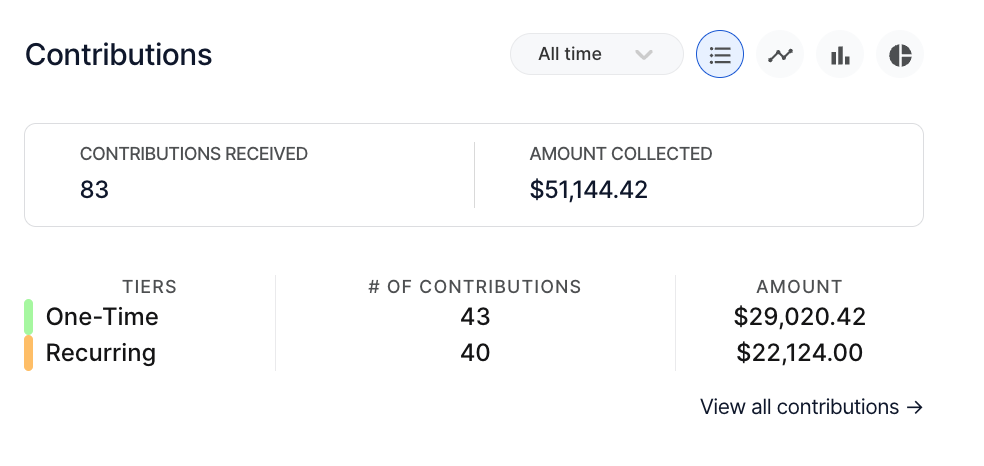
PostCSS and Autoprefixer funding over 13 years
Foundational open source is seamlessly invisible when working well, but you’ve all also seen what happens when it breaks.
Recent, high-profile vulnerabilities in open source primarily revolved around supply chain attacks, AI-driven exploitation, and critical flaws in widely-used libraries. Late 2025 to early 2026 cases include persistent attacks on package repositories:
- React2Shell (December 2025) — CVSS score of 10, compared to Log4Shell, a third of cloud providers potentially vulnerable
- Shai-Hulud (September 2025) — first self-replicating npm malware, compromised 500+ packages in days
- 454,600 malicious packages found in 2025 alone
The endowment model
Harvard, Oxford, MIT don’t spend their donations. They invest these resources in diversified portfolios and spend only the annual returns. The principal stays intact forever.
OSE applies that logic to open source and its global community, which also has its own “students” (junior developers) and “alumni” (senior engineers, CTOs, founders). Every dollar donated becomes a permanent asset. Annual income, targeting 7-8% return with a 5% spend rate, funds microgrants to the most critical but underfunded projects.
A $10M endowment at 5% generates $500,000 every year, indefinitely. That’s $10-20K for 25-50 of the most critical projects in the ecosystem, paid out forever from a single capital raise.
Instead of focusing in vain on GitHub stars that tend to reward high-profile projects that already attract attention, the goal is to support foundational, seemingly invisible projects. So, the grant selection is algorithmic: projects are scored on Value (downloads, dependents, community nominations) and Risk (active maintainer count, security score, existing funding).
However, it’s not fully automatic-the OSE team will perform a manual review of the top candidates, and the board would approve grants only after due diligence. The Endowment is also accepting community nominations, which will be used among its funding model inputs.
Why should devtool founders care?
The average app includes over 550 OSS components. If you’re building a developer tool, your product depends on infrastructure you didn’t create and can’t replace. Cybersecurity Ventures predicts that the global annual cost of software supply chain attacks to businesses will reach a staggering $138 billion by 2031, up from $60 billion in 2025. This risk lives in your dependency tree right now.
Who’s already in:
Mitchell Hashimoto (co-founder of HashiCorp). Maxim Konovalov (co-founder of Nginx). Evan You (creator of Vue.js and Vite). Daniel Stenberg (founder of cURL). Alexey Milovidov (co-founder and CTO of ClickHouse). Thomas Dohmke (ex-CEO of GitHub). Chad Whitacre (Head of Open Source at Sentry). And many other thought leaders in the devtools space.
Helping OSE reach you
When Konstantin reached out to us, we wanted to offer our support. Evil Martians became a founding pro-bono donor for OSE, designing the logo and website, and our CEO Irina Nazarova joined as an individual member donor.
Evil Martians (Roman Shamin, Anton Lovchikov, Yaroslav Lozhkin) delivered high-fidelity Figma designs for the main page and a content page template, in desktop and mobile layouts. The design system included typography styles, a color system supporting light and dark themes, core UI components and reusable blocks, and all original illustrations.

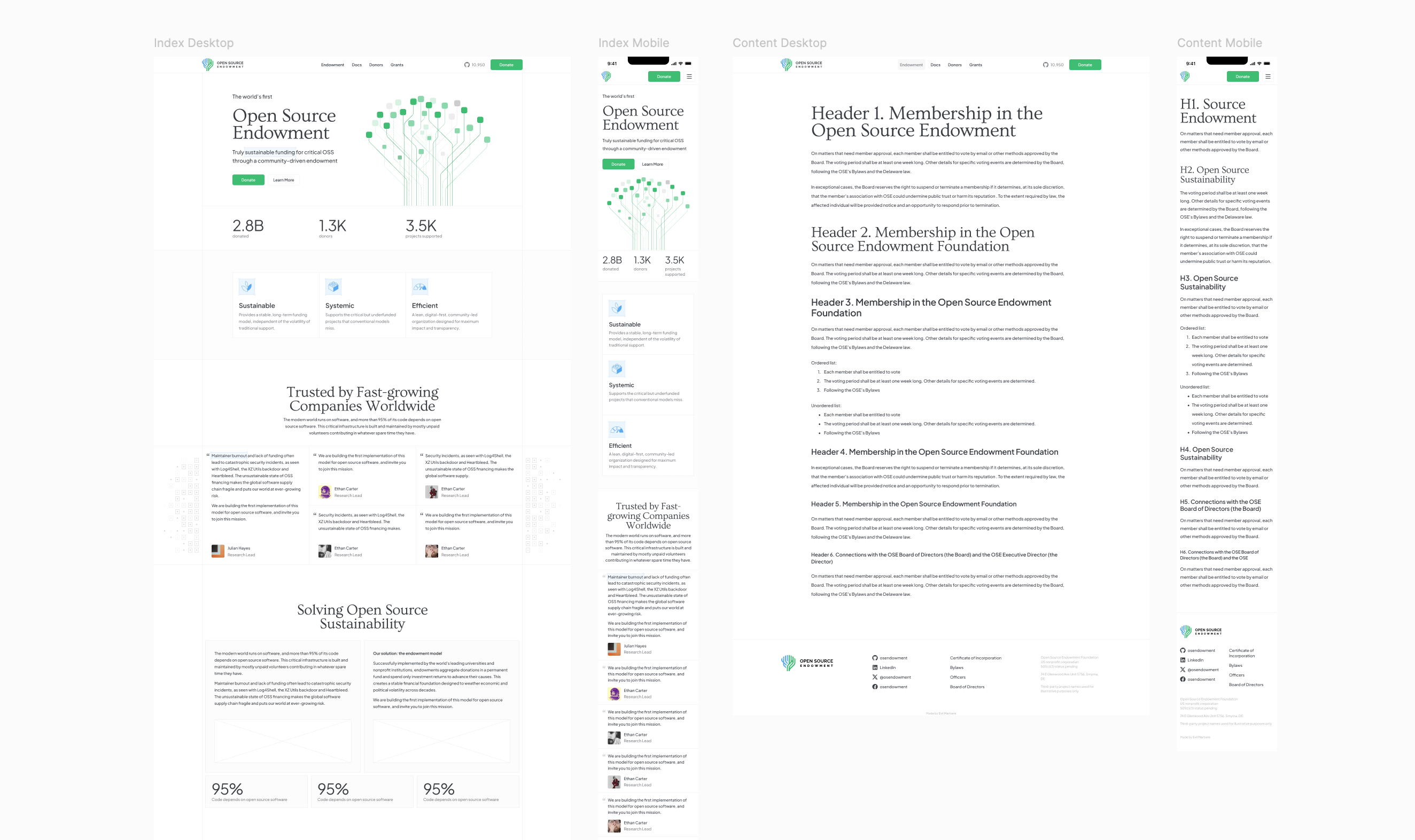
High-fidelity Figma designs for the OSE website in desktop and mobile layouts
Our Martian designers began by shaping up the new brand. We focused on metaphors recognized by both developers and institutional donors. The final mark resembles something of a dependency tree growing from an open hand. An emerald green and sky blue palette bridges the spirit of charity and the world of developer tools.

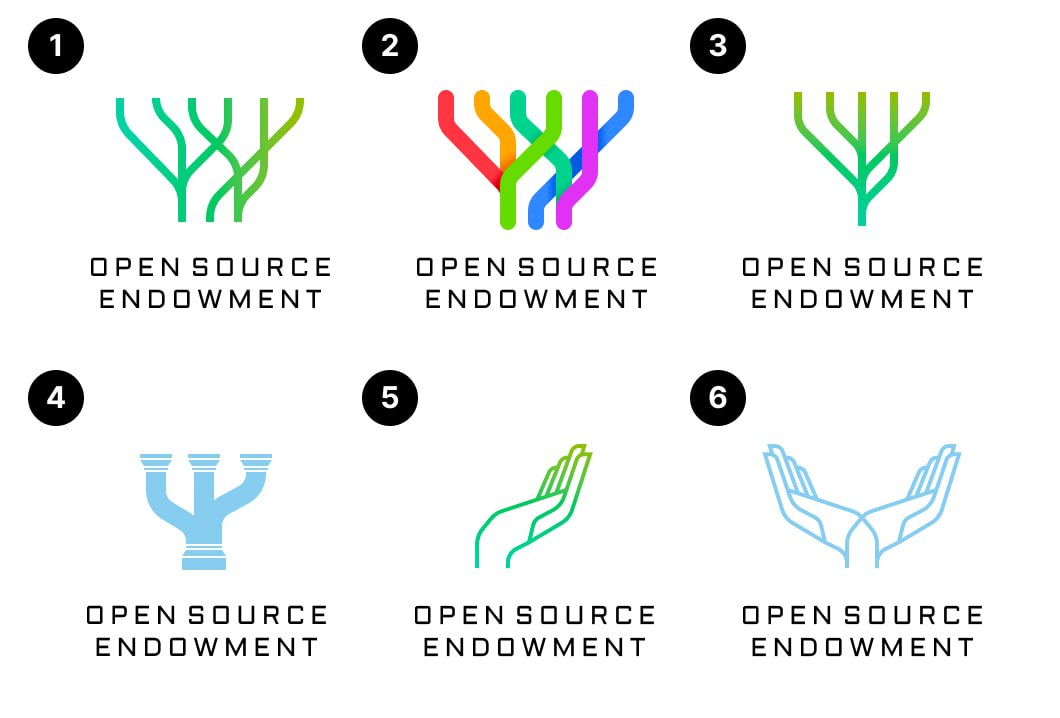
Logo exploration for Open Source Endowment
The website also needed to make its audience feel that their donation would be handled with integrity. Having studied 100+ devtool landing pages, we knew exactly how to frame OSE’s narrative.
Clarity and social proof, the two pillars of technical marketing, became the foundation for this project:
- Clarity meant making the endowment model genuinely understandable. How does money flow in? What gets invested?
- Social proof meant real names, real faces, real numbers.

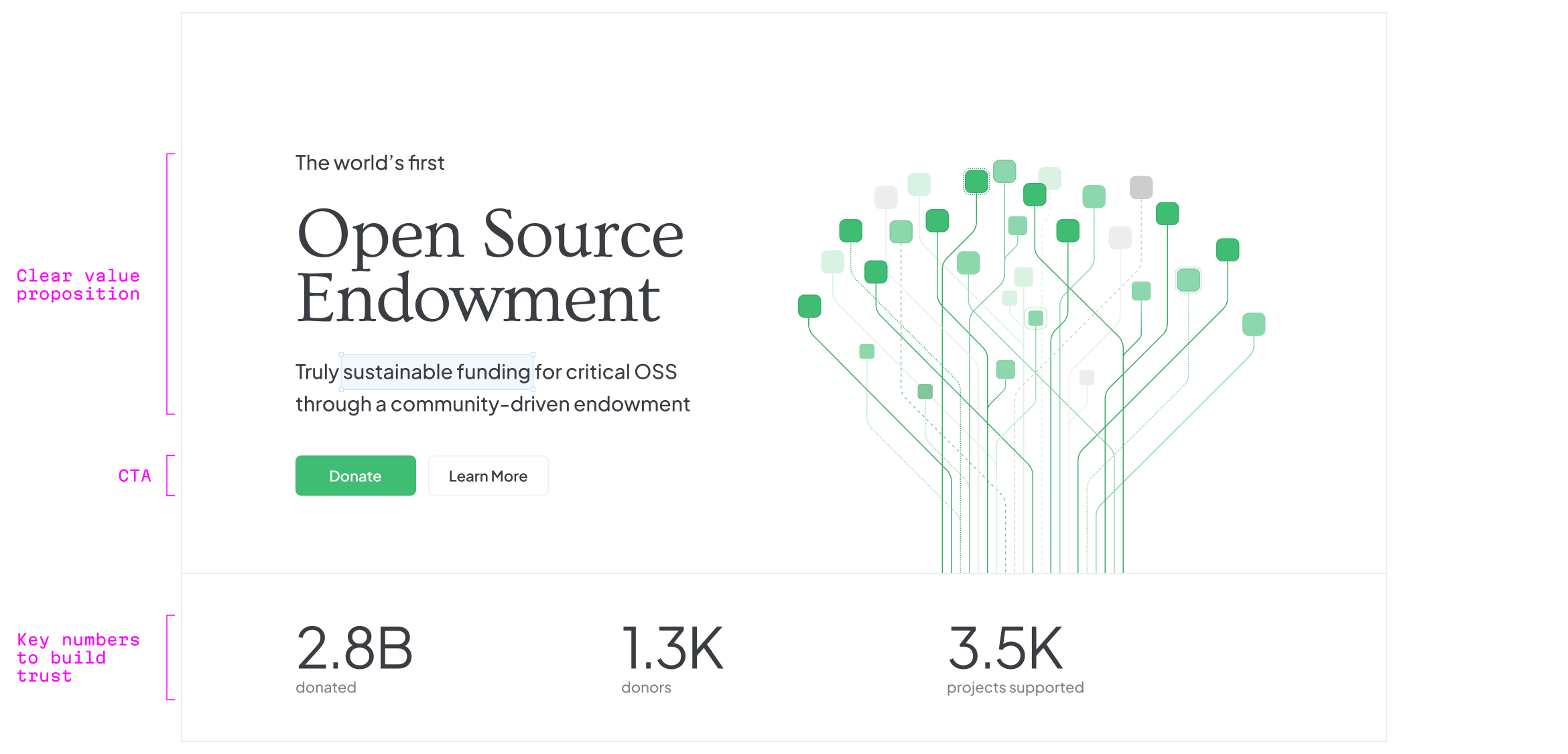
The hero section of endowment.dev
The color system—white, black, green, blue—reflects the OSE logo and brings this closer to a well-run infrastructure company than a charity.

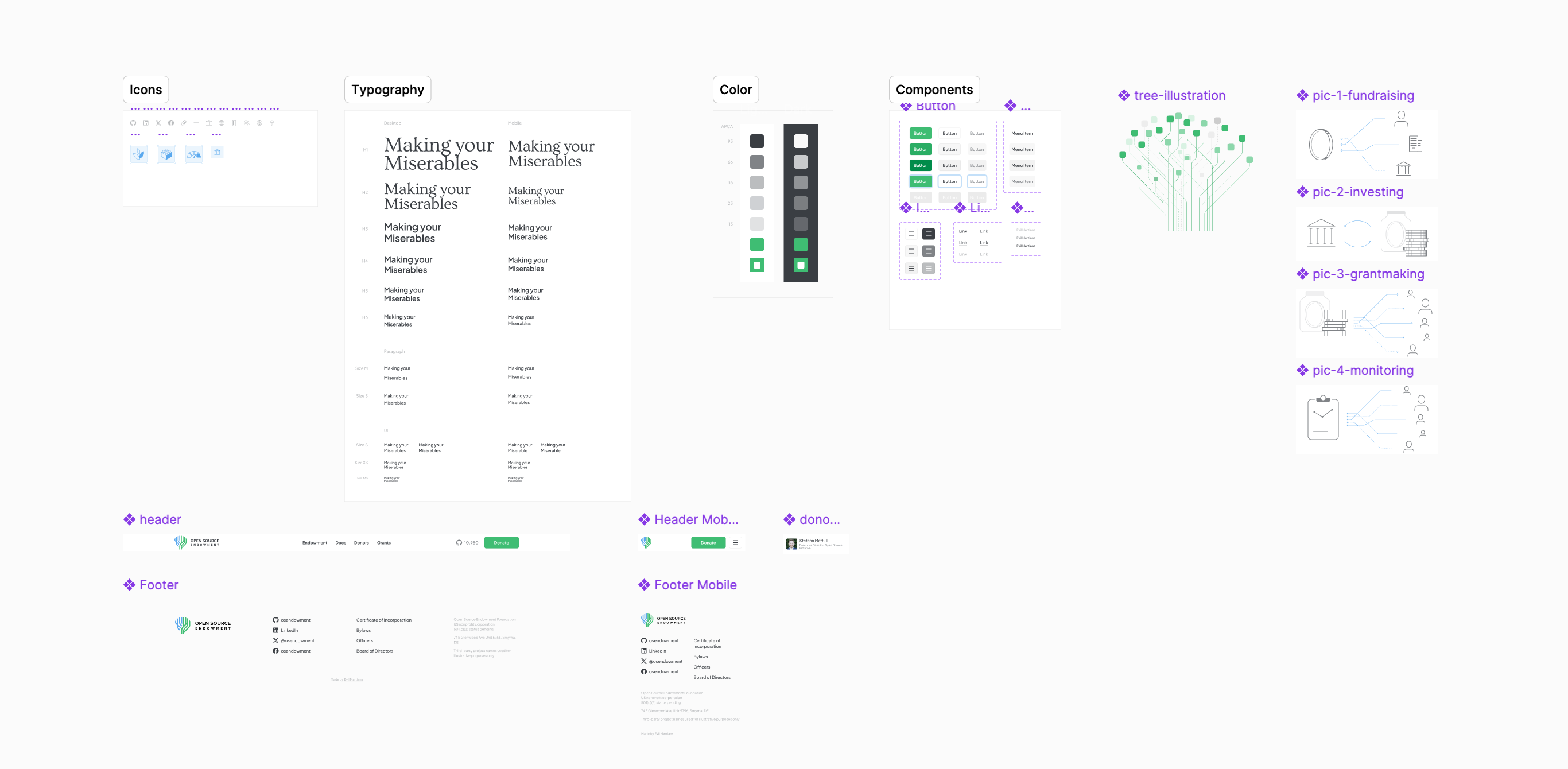
Design system library with typography, color palette, UI components, and original illustrations
For typography, we paired Ovo by Nicole Fally, a serif with medium contrast, open apertures, and humanist proportions for headlines, with Plus Jakarta Sans, a clean geometric sans-serif by Gumpita Rahayu, for body text. Tradition and progress in the same composition.
The hero illustration shows a tree whose branches represent individual OSS projects, each growing in its own direction but emerging from a shared trunk. The same concept lives in the logo: the endowment doesn’t pick winners, it strengthens the whole ecosystem.
Get involved!
The fund currently holds $678K+. The first grant distribution is planned for Q2 2026.
Individual membership starts at $1,000 per year. This gets you genuine governance participation alongside the people who built Nginx, cURL, Vue.js, and HashiCorp.
Visit endowment.dev to learn more or donate.